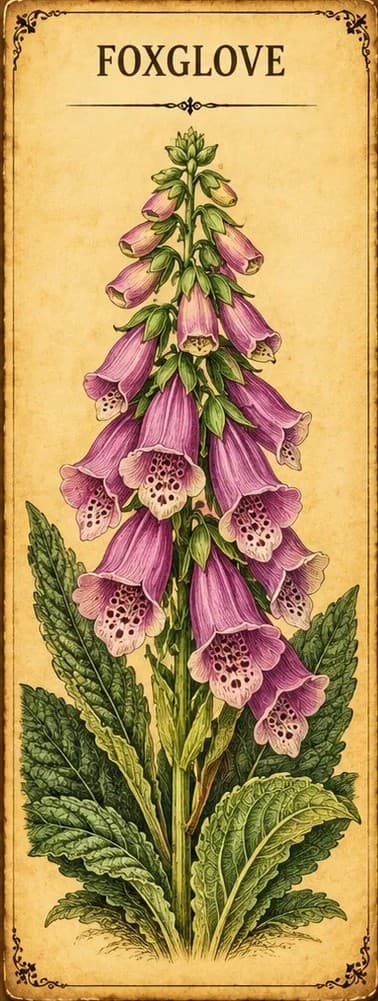
Foxglove
Digitalis purpurea
A tall garden flower and the source of digitalis heart medicines. All parts of the plant are poisonous and affect the heart.
What is Foxglove?
- Plant family
- Plantaginaceae, the plantain family
- Parts used
- None for home use: all parts are poisonous. Heart medicines (digitalis glycosides) were developed from foxglove.
- Genus
- Digitalis
- Species
- purpurea
Also called
Digitalis, Digitalis purpurea, Digitalis lanata, Fairy Glove, Folk's Glove, Witch's Bells, Dead Man's Bells
Traditionally used for
- Source of heart medicines (not for home use)
Traditionally described as
Health topics
Where Foxglove appears in symptom search, and why. Being listed doesn't mean it's a proven treatment.
- Poisonous Plants
All parts are poisonous and affect the heart.
Safety
Toxicity testing
Foxglove is poisonous. Its flowers, leaves, stems and seeds contain heart-affecting compounds (digitalis glycosides such as digitoxin). Poisoning usually happens from sucking the flowers or eating the seeds, stems or leaves, or from taking too much of a heart medicine made from foxglove. Signs include:
- Irregular or slow heartbeat, collapse and very low blood pressure (shock)
- Nausea, vomiting, diarrhoea and stomach pain
- Blurred vision and yellow, green or white halos around objects
- Confusion, hallucinations, drowsiness and weakness
Get emergency help right away; in the US, Poison Help is 1-800-222-1222. Don't make the person vomit unless told to. With fast treatment, death is unlikely, but a hospital stay may be needed.[1]
What does the research say?
Traditional use
These are traditional uses, not proven treatments.
Medical history, not a home remedy: in 1785 the English physician William Withering published his observations on foxglove, describing both its use for "dropsy" (fluid build-up from heart failure) and its poisonous effects. Heart-strengthening compounds (cardiac glycosides) were later isolated from it, and standardized digitalis medicines were a mainstay of heart failure treatment for about 200 years. Newer medicines have since largely taken their place.[2]
In short
Poisonous. Do not eat or suck any part of the plant. Get emergency help if swallowed.
Sources
- [1] Foxglove poisoning. MedlinePlus Medical Encyclopedia — U.S. National Library of Medicine (NIH)Government health agency
- [2] Congestive Heart Failure: A History · DOI: 10.4103/HEARTVIEWS.HEARTVIEWS_77_19Peer-reviewed study
This information is educational and traditional in nature, and is not a substitute for professional medical advice.