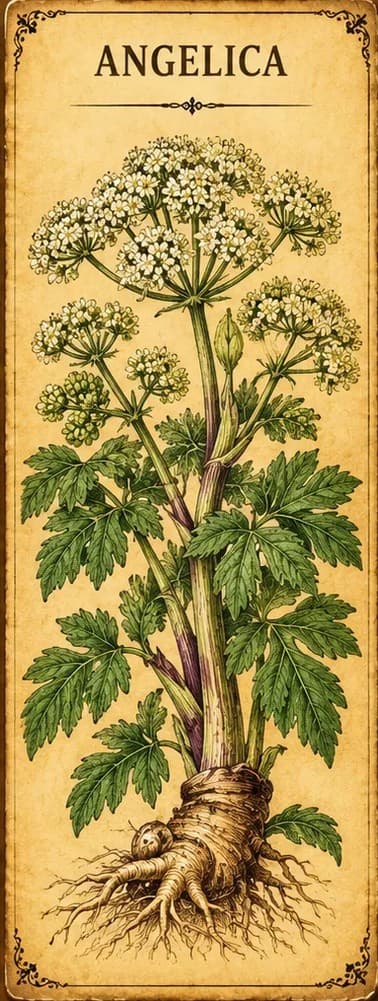
Angelica
Angelica archangelica
Garden angelica, an aromatic plant used to flavour food and known in folk medicine as the "angel plant". Research is in the lab and in animals.
What is Angelica?
- Plant family
- Apiaceae, the carrot and parsley family
- Parts used
- The root, seeds and stems, used for flavouring and in traditional medicine
- Genus
- Angelica
- Species
- archangelica
Also called
Garden Angelica, Angelica archangelica
Traditionally used for
- Flavouring
- Traditional remedy
Traditionally described as
Safety
Toxicity testing
Angelica root contains furocoumarins, natural compounds that can make skin react to sunlight. Europe's medicines agency says many of them can damage DNA and cause cancer when combined with UV light, and that their risk in herbal products is uncertain because data are lacking. Some furocoumarins are also eaten in everyday foods.[1]
Technical detail: photogenotoxic and photocarcinogenic; risk assessed against 8-methoxypsoralen (8-MOP) as a worst case.
What does the research say?
Traditional use
These are traditional uses, not proven treatments.
Garden angelica is an aromatic plant used to flavour food. In traditional medicine it's called the "angel plant" because of the healing powers once credited to it.[2]
Laboratory & animal research
Lab and animal results show what might be worth studying in people. They don't show that the herb has these effects in humans.
In lab and animal studies, angelica extracts and their compounds (mainly coumarins and essential oils) have shown calming and anti-seizure effects, effects on memory, antiviral and stomach-protecting activity, and reduced inflammation. These haven't been confirmed in people.[2]
In short
Contains furocoumarins, which can make skin react to sunlight.
Sources
- [1] Reflection paper on the risks associated with furocoumarins contained in preparations of Angelica archangelica L. (EMEA/HMPC/317913/2006) — European Medicines Agency, Committee on Herbal Medicinal Products (HMPC)Government health agency
- [2] Understanding the phytochemistry and molecular insights to the pharmacology of Angelica archangelica L. (garden angelica) and its bioactive components · DOI: 10.1002/ptr.7206Peer-reviewed study
This information is educational and traditional in nature, and is not a substitute for professional medical advice.