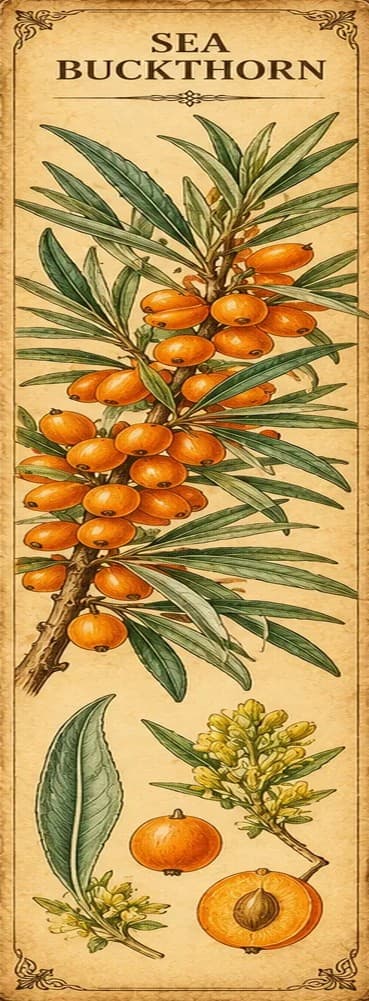
Sea Buckthorn
Hippophae rhamnoides
An orange berry eaten as juice, oil and food, and used in traditional Chinese medicine for cough and digestion. Trials suggest it may improve blood fats in people with abnormal levels.
What is Sea Buckthorn?
- Plant family
- Elaeagnaceae, the oleaster family, which includes sea buckthorn
- Parts used
- The berries (as juice, oil and food), and other parts in traditional Chinese medicine
- Genus
- Hippophae
- Species
- rhamnoides
Also called
Hippophae rhamnoides
Traditionally used for
- Food and juice
- Cough and digestion (traditional)
- Cholesterol (studied)
Traditionally described as
- Antioxidant (in lab studies)
Health topics
Where Sea Buckthorn appears in symptom search, and why. Being listed doesn't mean it's a proven treatment.
- High Cholesterol
A review of 15 trials found it improved blood fats in people whose levels were already abnormal.
Traditions that use it
Traditional Chinese Medicine
Used since ancient times to relieve cough, aid digestion, get the blood moving and ease pain.
What does the research say?
Traditional use
These are traditional uses, not proven treatments.
Sea buckthorn is eaten as a food and taken as a supplement worldwide, as juice, wine, oil, ferments and yogurt. In traditional Chinese medicine, different parts of the plant have been used since ancient times to relieve cough, aid digestion, get the blood moving and ease pain.[1]
Laboratory & animal research
Lab and animal results show what might be worth studying in people. They don't show that the herb has these effects in humans.
The berries contain many plant compounds, including flavonoids, vitamins and minerals. In lab and animal studies, extracts have acted as antioxidants, reduced inflammation and shown liver-protecting, blood-sugar-lowering and blood-fat-lowering effects. Possible toxicity still needs more study.[1]
Research in people
A 2022 review of 15 trials found sea buckthorn lowered triglycerides, total and LDL ("bad") cholesterol and raised HDL ("good") cholesterol, but only in people whose blood fats were already abnormal. It didn't change blood sugar, blood pressure or BMI. The results varied a lot between studies, and more trials are needed.[2]
Technical detail: triglycerides SMD −0.72 (95% CI −1.13 to −0.32); total cholesterol SMD −0.35 (−0.64 to −0.05); LDL SMD −0.40 (−0.76 to −0.04); HDL SMD 0.37 (0.06 to 0.68).
Sources
- [1] Hippophae rhamnoides L.: A Comprehensive Review on the Botany, Traditional Uses, Phytonutrients, Health Benefits, Quality Markers, and Applications · DOI: 10.1021/acs.jafc.2c06916Peer-reviewed study
- [2] Effects of sea buckthorn (Hippophae rhamnoides L.) on factors related to metabolic syndrome: A systematic review and meta-analysis of randomized controlled trial · DOI: 10.1002/ptr.7596Review or clinical trial
This information is educational and traditional in nature, and is not a substitute for professional medical advice.