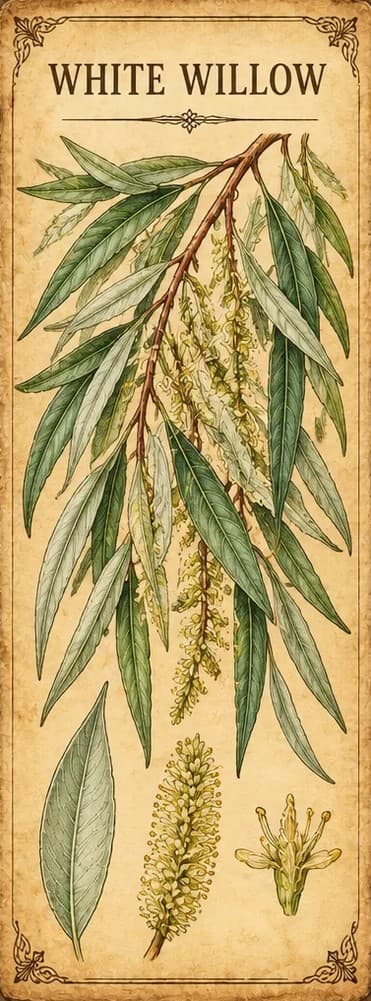
White Willow
Salix alba
Willow bark, a natural source of salicin, a relative of aspirin. Recognized in Europe for short-term lower back pain, and traditionally for joint pain, fever and headache.
White Willow may interact with some medicines. If you take any medicine, read Interactions with medicines below and talk to your doctor or pharmacist before using it.
What is White Willow?
- Plant family
- Salicaceae, the willow family
- Parts used
- The dried bark, as a tea or extract
- Genus
- Salix
- Species
- alba
Also called
Willow Bark, Salix alba
Traditional names
Salicis Cortex
Traditionally used for
- Lower back pain
- Arthritis pain (studied)
- Joint pain
- fever and headache (traditional)
Traditionally described as
- Contains salicin (related to aspirin)
Health topics
Where White Willow appears in symptom search, and why. Being listed doesn't mean it's a proven treatment.
- Fever
Recognized in Europe as a traditional medicine for fever with a cold.
- Headache
Recognized in Europe as a traditional medicine for headache.
- Joint Discomfort
A review of 6 trials found willow bark eased arthritis pain more than a dummy pill; evidence is still weak.
Traditions that use it
European Folk Medicine
Recognized in Europe for short-term lower back pain, and traditionally for minor joint pain, fever with colds and headache.
Natural compounds
Safety
Interactions with medicines
Willow bark can increase the risk of bleeding in vulnerable people, and taking it with other salicylate medicines such as aspirin adds to the risks. 240 mg of salicin can make more salicylic acid than a low-dose (81 mg) aspirin tablet, but supplements aren't required to carry aspirin's warnings.[1]
Who should avoid it
Don't take willow bark if you're allergic to aspirin or related painkillers (NSAIDs), or if you have asthma triggered by salicylates, an active stomach ulcer, severe liver or kidney problems, a bleeding disorder or G6PD deficiency. Children, teenagers and women in the last three months of pregnancy must not take it, and adults shouldn't take it for more than 4 weeks for pain.[2]
Side effects
Reported side effects include allergic reactions (rash, itching and asthma) and stomach and gut symptoms such as nausea, vomiting, belly pain, diarrhoea and heartburn. How often these happen isn't known.[2]
Trials giving 120–240 mg of salicin a day for up to 8 weeks found no serious side effects. The most common side effects were stomach and gut problems, with a few allergic reactions. All the trials were in adults.[1]
Pregnancy
Salicylates cross the placenta and are cleared slowly by newborns, and the United States Pharmacopeia says willow bark products shouldn't be used by women who are pregnant or breastfeeding, or by children, because of the risk of Reye syndrome.[1]
What does the research say?
Traditional use
These are traditional uses, not proven treatments.
Based on long-standing use, the European Medicines Agency recognizes willow bark as a traditional herbal medicine for adults to relieve:
- Minor joint pain
- Fever with a cold
- Headache
This rests on at least 30 years of safe use, not on proof from clinical trials. The agency's summary covers several willow species.[2]
Research in people
A 2023 review of 6 trials with 329 people with arthritis found willow bark relieved pain and improved physical function more than a dummy pill, with no more side effects. Because of possible bias in the trials, the evidence is still weak and more trials are needed.[3]
The European Medicines Agency accepts willow bark dry extract as a well-established medicine for short-term lower back pain, because several clinical studies found it worked better than a dummy pill. Willow bark contains salicin, which the body turns into salicylic acid, a relative of aspirin. The amount made is small, so other compounds in the bark may also play a part.[2]
In short
Avoid if allergic to aspirin, in children and teens, late pregnancy, or with bleeding disorders or blood thinners.
Sources
- [1] United States Pharmacopeia Safety Review of Willow Bark · DOI: 10.1055/a-1007-5206Peer-reviewed study
- [2] Willow bark (Salix spp., cortex): summary for the public (EMA/97861/2017) — European Medicines Agency, Committee on Herbal Medicinal Products (HMPC)Government health agency
- [3] Willow Bark (Salix spp.) Used for Pain Relief in Arthritis: A Meta-Analysis of Randomized Controlled Trials · DOI: 10.3390/life13102058Review or clinical trial
This information is educational and traditional in nature, and is not a substitute for professional medical advice.