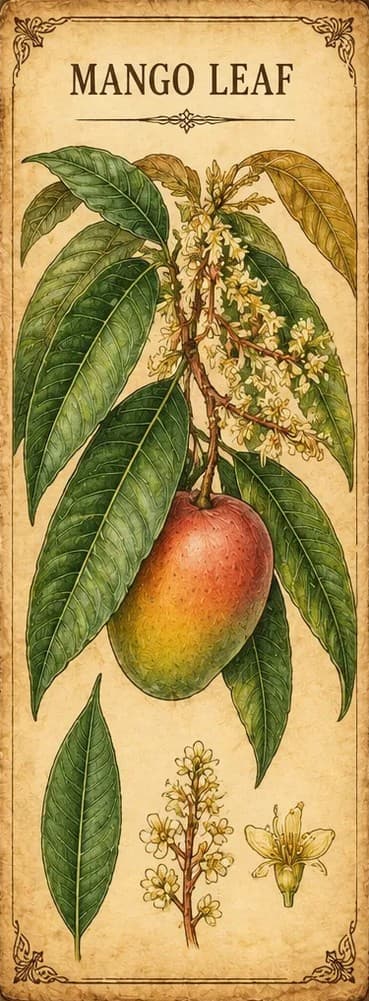
Mango Leaf
Mangifera indica
The leaves of the mango tree, made into a folk tea in Asia and Africa and traditionally used for diabetes, breathing problems and diarrhea. Research is mostly in the lab and in animals.
What is Mango Leaf?
- Plant family
- Anacardiaceae, the cashew and mango family
- Parts used
- The leaves, as a tea or extract
- Where it grows
- South and Southeast Asia; grown widely in the tropics
- Genus
- Mangifera
- Species
- indica
Also called
Mangifera indica, Mango Leaves
Traditionally used for
- Diabetes (traditional)
- Breathing problems (traditional)
- Diarrhea (traditional)
Traditionally described as
- Antioxidant (in lab studies)
Health topics
Where Mango Leaf appears in symptom search, and why. Being listed doesn't mean it's a proven treatment.
- High Blood Sugar
Traditionally used for diabetes; lowered blood sugar in lab and animal studies, but not tested for this in people.
Natural compounds
What does the research say?
Traditional use
These are traditional uses, not proven treatments.
Mango leaves are made into a folk tea, especially in Asian and African countries. Traditionally, leaf extracts have been used for:
- Diabetes
- Bronchitis, asthma and other breathing problems
- Diarrhea
- Kidney and urinary problems
- Scabies
- Syphilis
Laboratory & animal research
Lab and animal results show what might be worth studying in people. They don't show that the herb has these effects in humans.
Mango leaves are rich in mangiferin and other plant compounds. Lab and animal studies have reported that leaf extracts act as antioxidants and may lower blood sugar and blood fats, protect the liver, fight germs, and slow or kill some cancer cells. These effects haven't been confirmed in people.[1]
Research in people
In a 2024 trial, 114 healthy adults took a single 300 mg dose of mango leaf extract or a dummy pill. The extract didn't improve thinking or mood over the next 5 hours. It slightly increased mistakes on one subtraction test, which the researchers said should be treated with caution.[2]
Technical detail: randomized, double-blind, placebo-controlled crossover; extract standardised to at least 60% mangiferin; NCT05182450.
Sources
- [1] Mango (Mangifera indica L.) Leaves: Nutritional Composition, Phytochemical Profile, and Health-Promoting Bioactivities · DOI: 10.3390/antiox10020299Peer-reviewed study
- [2] Acute effects of mango leaf extract on cognitive function in healthy adults: a randomised, double-blind, placebo-controlled crossover study · DOI: 10.3389/fnut.2024.1298807Peer-reviewed study
This information is educational and traditional in nature, and is not a substitute for professional medical advice.