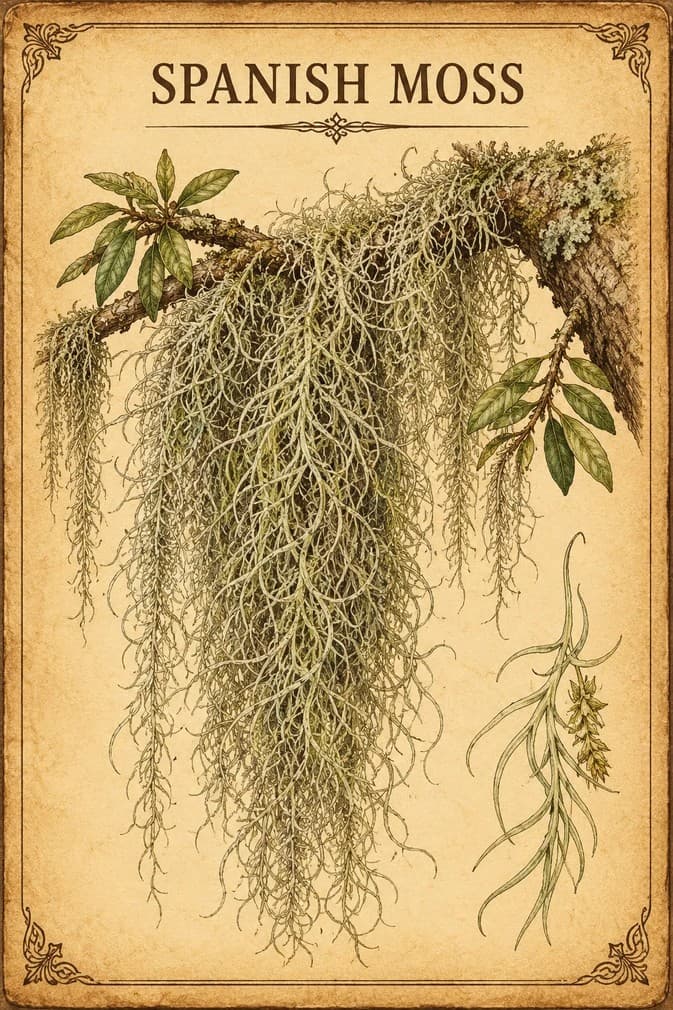
Spanish Moss
Tillandsia usneoides
A flowering plant in the pineapple family, not a true moss, that hangs from trees. Traditionally used for diabetes, high blood pressure and rheumatism; research so far is only in the lab and in mice.
What is Spanish Moss?
- Plant family
- Bromeliaceae, the pineapple and bromeliad family
- Parts used
- The whole plant
- Where it grows
- The Americas, from the southern United States to Central and northern South America
- Genus
- Tillandsia
- Species
- usneoides
Also called
Tillandsia usneoides
Traditionally used for
- Diabetes (traditional)
- High blood pressure (traditional)
- Rheumatism (traditional)
- Bronchitis and fever (traditional)
Traditionally described as
- Lowered blood sugar (in mice)
- Shrank breast tumours (in mice)
What does the research say?
Traditional use
These are traditional uses, not proven treatments.
Spanish moss isn't a true moss but a flowering plant in the pineapple family that hangs from trees. In traditional medicine it has been used for:
- Diabetes
- High blood pressure
- Rheumatism
- Haemorrhoids
- Kidney and eye problems
- Increasing bile and urine flow
Early records from the United States describe Spanish moss being fed to cattle in winter. When rotted in water it leaves a springy fibre, which was used to stuff mattresses, saddles and chairs and to make ropes.[2]
In traditional medicine the whole plant has been used for heart conditions, rheumatism, bronchitis, fever, ulcers and diabetes, and to increase urine flow. It's widespread in Colombia, growing up to 3,000 metres above sea level.[3]
Laboratory & animal research
Lab and animal results show what might be worth studying in people. They don't show that the herb has these effects in humans.
In mice, an extract of Spanish moss lowered blood sugar. A compound taken from it (a flavone) helped muscle and liver cells take up sugar in lab tests. It hasn't been tested in people.[4]
Technical detail: ethyl acetate fraction; 5,7,4´-trihydroxy-3,6,3´,5´-tetramethoxyflavone promoted GLUT4 translocation in C2C12 myoblasts and primary mouse hepatocytes.
In lab tests, an extract killed breast cancer and melanoma (skin cancer) cells. In mice, it shrank breast tumours and boosted immune cells that attack cancer, but it didn't shrink melanoma tumours. It hasn't been tested in people.[1]
Technical detail: ethanolic extract; 4T1 breast cancer and B16-F10 melanoma models; increased dendritic cells and activated CD8+ T cells, fewer regulatory T cells and myeloid-derived suppressor-like cells.
In a 2025 lab study, an extract of Spanish moss made rat brain cells grow more and longer branches (the connections nerve cells use to link up), at very low doses. The researchers think this could one day help protect the brain's ability to adapt, but it has only been tested on cells in a dish. At higher doses, some extracts reduced the number of living cells by about 20%.[3]
Technical detail: ethyl acetate fraction increased dendritic branching and dendrite length in primary cortical neurons from E18 Wistar rat embryos at 0.03–1 μg/mL, likely via PI3K/Akt and ERK1/2 signalling; contains 14 phenolic acids, 6 flavonoids and a triterpene; viability fell about 20% above 1 μg/mL for the ethanol extract and ethyl acetate fraction.
In short
Not tested in people.
Sources
- [1] Tillandsia usneoides Extract Decreases the Primary Tumor in a Murine Breast Cancer Model but Not in Melanoma · DOI: 10.3390/cancers14215383Peer-reviewed study
- [2] Plants of the USA: recordings on native North American useful species by Alexander von Humboldt · DOI: 10.1186/s13002-024-00727-3Peer-reviewed study
- [3] Active Fraction of Tillandsia usneoides Induces Structural Neuroplasticity in Cortical Neuron Cultures from Wistar Rats · DOI: 10.3390/ijms262311668Peer-reviewed study
- [4] GLUT4 translocation in C2C12 myoblasts and primary mouse hepatocytes by an antihyperglycemic flavone from Tillandsia usneoides · DOI: 10.1016/j.phymed.2021.153622Peer-reviewed study
This information is educational and traditional in nature, and is not a substitute for professional medical advice.