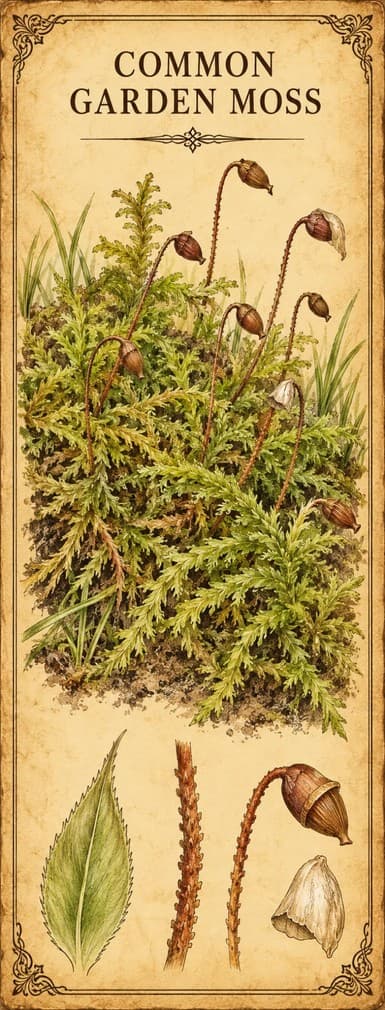
Common Garden Moss
Brachythecium rutabulum
Rough-stalked feather-moss, a common lawn and garden moss probably used in 17th- and 18th-century Europe for dressing wounds and stopping bleeding.
What is Common Garden Moss?
- Plant family
- Brachytheciaceae, a family of feather mosses
- Parts used
- The whole moss
- Where it grows
- Common across Europe, on soil, tree trunks, logs, stones and walls, and often in lawns and gardens
- Genus
- Brachythecium
- Species
- rutabulum
Also called
Brachythecium rutabulum, Rough-stalked Feather-moss
Traditionally used for
- Wound dressing (traditional)
- Stopping bleeding (traditional)
Traditionally described as
- Very absorbent
- Killed some bacteria and fungi (in lab studies)
Health topics
Where Common Garden Moss appears in symptom search, and why. Being listed doesn't mean it's a proven treatment.
- Cuts, Wounds, Burns and Skin Ulcers
Historically used as a wound dressing to stop bleeding; very absorbent in lab tests but not tested in people.
Traditions that use it
European Folk Medicine
Probably recommended for dressing wounds and stopping bleeding in the 17th and 18th centuries.
What does the research say?
Traditional use
These are traditional uses, not proven treatments.
This common moss of lawns and gardens was probably recommended for dressing wounds and stopping bleeding, at least between 1651 and 1731.[1]
Technical detail: recorded as "muscus terrestris et hortensis".
Two old European plant books, from 1651 and 1731, describe a "ground and garden moss" that healers used to stop bleeding. They said people learned this from bears, which pressed it on their wounds. A 2018 study matched the description to this moss: the most common moss of all, creeping on damp ground and invading gardens and wet meadows. This would mean moss wound dressings were in use more than 230 years before sphagnum dressings were developed in Germany in 1882. In the Himalayas, ash of this and other burnt mosses is mixed with fat and honey as an ointment for cuts, burns and wounds.[2]
Technical detail: described by Johann Bauhin (Historia Plantarum Universalis, 1651) and Boecler (Cynosura Materiae Medicae, 1731). The identification is well supported but not proven, as no herbarium specimens survive.
Laboratory & animal research
Lab and animal results show what might be worth studying in people. They don't show that the herb has these effects in humans.
In a lab test, 1 g of the dried moss soaked up about 16 g of water, more than two related mosses and about three-quarters as much as sphagnum. The researchers think this absorbency explains its old use to stop bleeding. Lab studies they cite found its extracts killed some bacteria and fungi, killed human cancer cells and acted as an antioxidant. None of this has been tested in people, and the researchers say more studies are needed.[2]
Technical detail: absorption 16.1 g water per g dry moss versus Rhytidiadelphus triquetrus 10.8 g and Homalothecium sericeum 11.7 g; extracts active against Bacillus subtilis, Escherichia coli, Staphylococcus aureus, Aspergillus flavus, Candida albicans and Trichophyton rubrum (Singh et al. 2007).
In short
Not tested in people.
Sources
- [1] Four Centuries of Medicinal Mosses and Liverworts in European Ethnopharmacy and Scientific Pharmacy: A Review · DOI: 10.3390/plants10071296Peer-reviewed study
- [2] Brachythecium rutabulum, A Neglected Medicinal Moss · DOI: 10.1007/s10745-017-9961-yPeer-reviewed study
This information is educational and traditional in nature, and is not a substitute for professional medical advice.