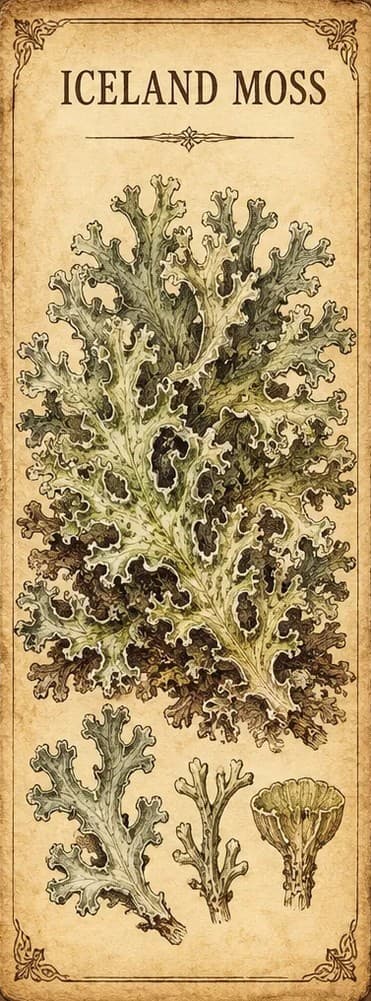
Iceland Moss
Cetraria islandica
A lichen, not a true moss, recognized in Europe as a traditional medicine to soothe throat irritation and dry cough, and for temporary loss of appetite.
What is Iceland Moss?
- Plant family
- Parmeliaceae, a large family of lichens
- Parts used
- The whole dried lichen, as a tea, extract, or lozenge
- Where it grows
- Northern regions; in North America from Alaska and Canada south to the Pacific Northwest, the Rocky Mountains, the Great Lakes, New England and the Appalachians
- Genus
- Cetraria
- Species
- islandica
Also called
Cetraria islandica, Iceland Lichen, Island Cetraria Lichen
Traditional names
Lichen Islandicus
Traditionally used for
- Sore throat and dry cough (traditional)
- Loss of appetite (traditional)
- Food (jellies and breads)
- Tuberculosis and fevers (historical)
Traditionally described as
Health topics
Where Iceland Moss appears in symptom search, and why. Being listed doesn't mean it's a proven treatment.
- Cough
Recognized in Europe as a traditional medicine for the dry cough that comes with throat irritation.
- Loss of Appetite
Recognized in Europe as a traditional medicine for temporary loss of appetite.
- Sore Throat
Recognized in Europe as a traditional medicine to soothe mouth and throat irritation.
Traditions that use it
European Folk Medicine
Recognized in Europe as a traditional herbal medicine for mouth and throat irritation, dry cough and loss of appetite.
Safety
Who should avoid it
For appetite loss it's for adults only; to soothe the throat it's for adults and children over 6. See a doctor if symptoms last longer than a week or get worse.[1]
Side effects
When the European Medicines Agency assessed Iceland moss medicines, no side effects had been reported.[1]
Contamination
Lichens, including Iceland moss, absorb radioactive fallout from the air.[2]
What does the research say?
Traditional use
These are traditional uses, not proven treatments.
Iceland moss isn't a true moss but a lichen. Based on long-standing use, the European Medicines Agency recognizes it as a traditional herbal medicine:
- To soothe mouth and throat irritation and the dry cough that comes with it (adults and children over 6)
- For temporary loss of appetite (adults only); its bitter-tasting lichen acids make this plausible
This rests on at least 30 years of safe use, not on proof from clinical trials.[1]
Iceland moss is one of the few lichens people eat. In northern Europe, the dried powder is boiled into a jelly for soups, and it's also added to breads and cereals. It has been used in the past for:
- Coughs
- Tuberculosis
- Fevers
- Scurvy
It has traditionally held an important place in Chinese medicine, and has been used as a source of antibiotics. It's also used to tan leather and to make a brown dye. It's harvested commercially in Iceland and Sweden; it grows only about 0.5 cm a year.[2]
Research in people
Small studies in people with inflammation of the mouth and throat suggested Iceland moss might improve symptoms. But few people took part, and it wasn't compared with a dummy treatment, so the results aren't reliable.[1]
Sources
- [1] Iceland moss (Cetraria islandica (L.) Acharius s.l., thallus): summary for the public (EMA/812331/2016) — European Medicines Agency, Committee on Herbal Medicinal Products (HMPC)Government health agency
- [2] Cetraria islandica, island cetraria lichen. Fire Effects Information System — U.S. Department of Agriculture, Forest Service, Rocky Mountain Research Station · DOI: 10.2737/feis-species-review-cetislGovernment health agency
This information is educational and traditional in nature, and is not a substitute for professional medical advice.