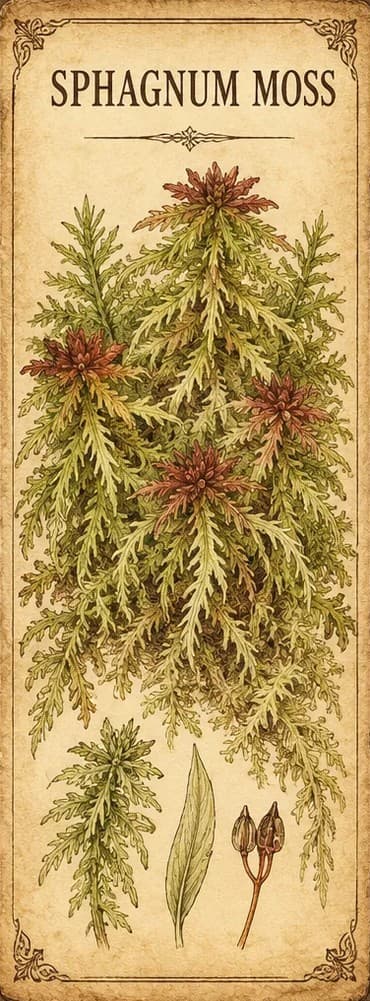
Sphagnum Moss
Sphagnum spp.
Peat moss, a very absorbent bog moss used in Europe for centuries as a wound dressing and as nappies and bedding for babies.
What is Sphagnum Moss?
- Plant family
- Sphagnaceae, the peat moss family
- Parts used
- The whole dried moss
- Genus
- Sphagnum
- Species
- spp.
Also called
Peat Moss, Bog Moss, Sphagnum palustre
Traditionally used for
- Wound dressing (traditional)
- Baby nappies and bedding (traditional)
Traditionally described as
- Very absorbent
Health topics
Where Sphagnum Moss appears in symptom search, and why. Being listed doesn't mean it's a proven treatment.
- Cuts, Wounds, Burns and Skin Ulcers
Historically used as a wound dressing; not tested in modern trials.
Traditions that use it
European Folk Medicine
Used in Europe as a wound dressing, and as nappies and bedding for babies.
What does the research say?
Traditional use
These are traditional uses, not proven treatments.
Old European medical books record sphagnum moss being used:
- As nappies and bedding for babies, because it soaks up urine well
- As a dressing for wounds
- Boiled with beer and applied as a poultice to swollen feet in older people
When interest in medicinal mosses faded in the 1880s, sphagnum stayed in use as a source of wound dressings.[1]
Laboratory & animal research
Lab and animal results show what might be worth studying in people. They don't show that the herb has these effects in humans.
Sphagnum dressings can soak up 3 to 4 times as much as cotton ones. Lab research suggests a sugar-like substance in the moss (sphagnan) binds to proteins, which may trap bacteria and switch off the harmful substances they release. This is a proposed explanation for its use on wounds, not proof from studies in people.[2]
Technical detail: inactivation of enzymes by a Maillard reaction; the moss's complex pectin resembles immune-stimulating pectins from other wound-healing plants.
Sources
- [1] Four Centuries of Medicinal Mosses and Liverworts in European Ethnopharmacy and Scientific Pharmacy: A Review · DOI: 10.3390/plants10071296Peer-reviewed study
- [2] Concerning the wound-healing properties of Sphagnum holocellulose: the Maillard reaction in pharmacology · DOI: 10.1016/S0378-8741(03)00189-2Peer-reviewed study
This information is educational and traditional in nature, and is not a substitute for professional medical advice.