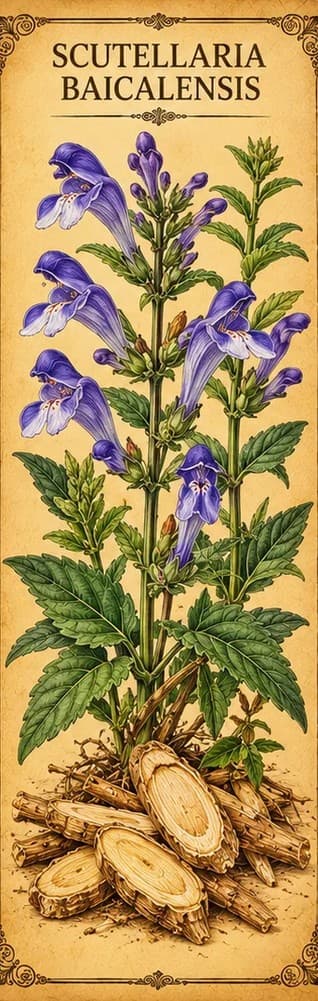
Scutellaria Baicalensis
Scutellaria baicalensis
Chinese skullcap, or huang qin, a root used in Chinese medicine for over 2,000 years for diarrhoea, bleeding, sleeplessness and lung infections. Most research is in the lab or on multi-herb formulas.
What is Scutellaria Baicalensis?
- Plant family
- Lamiaceae, the mint family
- Parts used
- The dried root
- Where it grows
- In China it comes mainly from Inner Mongolia, Sichuan, Shanxi, Shandong, Hebei and Henan
- Genus
- Scutellaria
- Species
- baicalensis
Also called
Chinese Skullcap, Baikal Skullcap
Traditional names
Huang Qin, Huangqin, Scutellariae Radix
Traditionally used for
- Diarrhoea and dysentery (traditional)
- Lung infections (traditional)
- Bleeding (traditional)
Traditionally described as
- Killed cancer cells (in lab studies)
Health topics
Where Scutellaria Baicalensis appears in symptom search, and why. Being listed doesn't mean it's a proven treatment.
- Colds and Nasal Congestion
Clinical reports suggest it may help colds; better trials are needed.
- Diarrhea
Traditionally used for diarrhoea and dysentery. Not tested on its own in trials.
- High Blood Pressure
Listed for high blood pressure in the 1593 Compendium of Materia Medica. Not tested on its own in trials.
Traditions that use it
Traditional Chinese Medicine
Called huang qin; used for over 2,000 years and listed in the Chinese Pharmacopoeia, traditionally to "clear heat", "dry dampness", stop bleeding and calm the unborn baby.
What does the research say?
Traditional use
These are traditional uses, not proven treatments.
Chinese people have used the dried root, called huang qin, for more than 2,000 years. It was first recorded around 200–250 AD in the Shennong Bencaojing (The Classic of Herbal Medicine) for lung and liver problems. The 1593 Compendium of Materia Medica lists it for:
- Diarrhoea and dysentery
- High blood pressure
- Bleeding
- Sleeplessness
- Inflammation
- Lung and airway infections
It's now listed in the Chinese Pharmacopoeia.[1]
In Chinese medicine, huang qin is used to "clear heat", "dry dampness", remove toxins, stop bleeding and calm the unborn baby to prevent miscarriage. It's an ingredient in many formulas, such as Huangqin decoction, used for dysentery and pain.[2]
Laboratory & animal research
Lab and animal results show what might be worth studying in people. They don't show that the herb has these effects in humans.
In lab studies, extracts and the root's main compounds (baicalin, baicalein, wogonin and wogonoside) killed or slowed many types of cancer cells, including brain, prostate, head and neck, lung, lymphoma, myeloma and leukaemia cells. In animal studies, it helped protect the liver from scarring.[1]
Research in people
Clinical reports suggest huang qin alone may help colds and bacterial pneumonia. It's also a main ingredient in Chinese herbal formulas that, in clinical studies, improved liver test results in hepatitis and, alongside chemotherapy, improved quality of life or survival in lung cancer. These were mostly formulas with several herbs, so the effect of huang qin itself is unclear.[1]
In short
Not the same plant as the American skullcap on the Skullcap page.
Sources
- [1] Scutellaria baicalensis, the golden herb from the garden of Chinese medicinal plants · DOI: 10.1007/s11434-016-1136-5Peer-reviewed study
- [2] Recent advances in Scutellariae radix: A comprehensive review on ethnobotanical uses, processing, phytochemistry, pharmacological effects, quality control and influence factors of biosynthesis · DOI: 10.1016/j.heliyon.2024.e36146Peer-reviewed study
This information is educational and traditional in nature, and is not a substitute for professional medical advice.