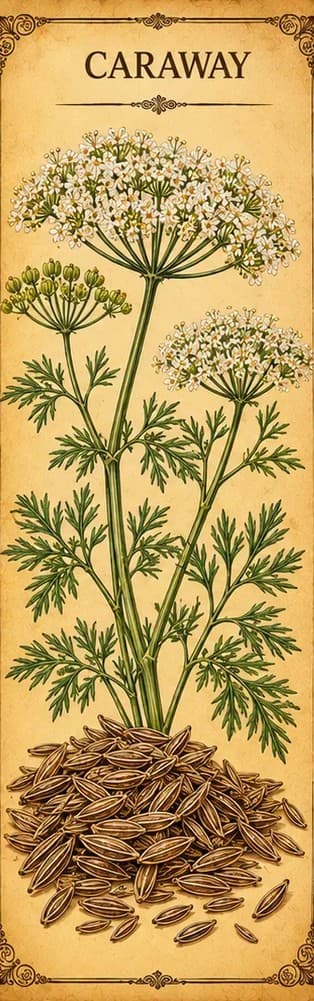
Caraway
Carum carvi
A carrot-family plant whose fruit (seeds) is used as a spice and, in Europe, as a traditional tea for bloating and wind.
What is Caraway?
- Plant family
- Apiaceae, the carrot and parsley family
- Parts used
- The fruit (often called seeds), usually as a herbal tea
- Where it grows
- Cultivated or gathered for its fruit
- Genus
- Carum
- Species
- carvi
Also called
Carum carvi, Caraway Seed
Traditionally used for
- Cooking spice
- Bloating and wind (traditional)
- Indigestion (with peppermint oil)
Traditionally described as
Health topics
Where Caraway appears in symptom search, and why. Being listed doesn't mean it's a proven treatment.
- Bloating
Recognized in Europe as a traditional medicine for bloating and wind.
- Indigestion
A caraway oil and peppermint oil combination eased indigestion in trials paid for by its maker.
Traditions that use it
European Folk Medicine
Recognized in Europe as a traditional herbal medicine for bloating and wind, based on long-standing use.
Safety
Who should avoid it
Caraway fruit medicines are for adults and children over 12. See a doctor if symptoms last longer than 2 weeks.[1]
Allergies
Don't use caraway medicines if you're allergic to caraway or other carrot-family plants (fennel, anise, celery, coriander and dill), or to mugwort or birch.[1]
Side effects
When the European Medicines Agency assessed caraway fruit medicines, no side effects had been reported.[1]
What does the research say?
Traditional use
These are traditional uses, not proven treatments.
Based on long-standing use, the European Medicines Agency recognizes caraway fruit as a traditional herbal medicine to relieve digestive problems such as bloating and wind. It's usually taken as a tea, by adults and children over 12. This rests on at least 30 years of safe use, not on proof from clinical trials; the agency noted a lack of studies in patients.[1]
Research in people
Caraway oil has been tested together with peppermint oil in a product called Menthacarin. A 2022 review of 5 trials with 580 people with indigestion that has no clear cause found the combination eased symptoms better than a dummy pill, and about as well as a comparison medicine. Combining 3 of the trials (249 people) showed less stomach pain and more people feeling much better. The review was paid for by the product's maker. These results are for the oil combination, not caraway tea.[2]
Technical detail: functional dyspepsia; pain intensity SMD 0.80 (95% CI 0.39 to 1.21); Clinical Global Impression item 2, RR 2.65 (95% CI 1.81 to 3.87).
In a 2013 trial, 70 overweight or obese women who exercised took 30 mL of caraway extract or a dummy drink every day for 90 days, without changing their diet. The caraway group lost more weight and body fat and had a smaller waist-to-hip ratio. Cholesterol and blood pressure didn't change, and no side effects were seen.[3]
Technical detail: body mass index and body fat percentage fell versus placebo.
In short
Avoid if allergic to carrot-family plants, mugwort or birch.
Sources
- [1] Caraway fruit (Carum carvi L., fructus): summary for the public (EMA/498568/2015) — European Medicines Agency, Committee on Herbal Medicinal Products (HMPC)Government health agency
- [2] Menthacarin, a Proprietary Peppermint Oil and Caraway Oil Combination, Improves Multiple Complaints in Patients with Functional Gastrointestinal Disorders: A Systematic Review and Meta-Analysis · DOI: 10.1159/000528553Review or clinical trial
- [3] Antiobesity effect of caraway extract on overweight and obese women: a randomized, triple-blind, placebo-controlled clinical trial — Evidence-Based Complementary and Alternative Medicine · DOI: 10.1155/2013/928582Peer-reviewed study
This information is educational and traditional in nature, and is not a substitute for professional medical advice.