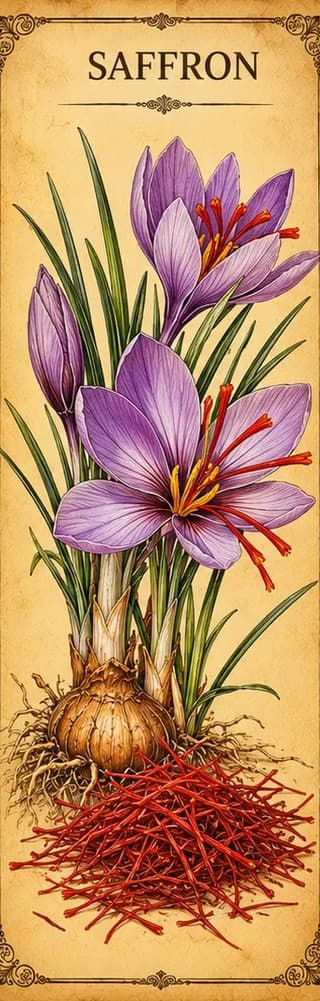
Saffron
Crocus sativus
A costly spice made from the red threads of the saffron crocus flower, used for thousands of years in Chinese and Persian medicine. Small trials, all in Iran, suggest it may help depression.
Saffron may interact with some medicines. If you take any medicine, read Interactions with medicines below and talk to your doctor or pharmacist before using it.
What is Saffron?
- Plant family
- Iridaceae, the iris family
- Parts used
- The dried stigmas (the red threads inside the flower)
- Where it grows
- Native to regions such as Spain, India and Iran; Iran produces about 90% of the world's saffron
- Genus
- Crocus
- Species
- sativus
Also called
Crocus sativus
Traditionally used for
- Cooking spice
- Low mood (traditional)
- Depression (small trials)
Traditionally described as
Traditions that use it
Traditional Chinese Medicine
Used for thousands of years in traditional Chinese medicine.
Safety
Interactions with medicines
Saffron may affect blood clotting. One person taking the blood thinner rivaroxaban had sudden bleeding that stopped when both were stopped. Take extra care if you use blood thinners or anti-platelet medicines, and watch for unusual bleeding.[1]
Who should avoid it
The reviewers advise extra caution with medicinal doses in older people and people with mental health conditions, and supervision by a doctor for high doses or long-term use.[1]
Side effects
A 2026 review of 102 trials found saffron is generally well tolerated at usual doses (15–100 mg a day) for short periods. About 1 in 6 people had a side effect, most often mild stomach and gut problems that went away on their own. Headache, less appetite, nausea and dry mouth were also reported. Saffron in normal food amounts (usually under 30 mg a day) is considered safe.[1]
Pregnancy
There's little safety information on medicinal doses of saffron in pregnancy or breastfeeding, so caution is advised.[1]
What does the research say?
Traditional use
These are traditional uses, not proven treatments.
Saffron is a costly spice made from the dried red threads (stigmas) of the saffron crocus flower. It has been used for thousands of years in traditional Chinese medicine, and medieval Persian doctors valued it for low mood, anxiety, pain and sex drive.[1]
Research in people
A 2019 review combined 8 small trials in people with depression. Saffron worked about as well as fluoxetine (a common antidepressant), and looked better than a dummy pill, though that result was only just short of being clear. All the trials were done in Iran and lasted 6 to 12 weeks, so the reviewers said more and longer high-quality studies, in other countries too, are needed.[2]
Technical detail: saffron vs placebo SMD −0.86 (95% CI −1.73 to 0.00, 4 trials); saffron vs fluoxetine 20–40 mg SMD 0.11 (95% CI −0.20 to 0.43, 4 trials).
In short
May increase bleeding risk with blood thinners. Little is known about medicinal doses in pregnancy.
Sources
- [1] Adverse Events of Saffron (Crocus sativus L.): Systematic Review of Current Evidence · DOI: 10.1002/hsr2.72212Review or clinical trial
- [2] The efficacy of Crocus sativus (Saffron) versus placebo and Fluoxetine in treating depression: a systematic review and meta-analysis · DOI: 10.2147/PRBM.S199343Review or clinical trial
This information is educational and traditional in nature, and is not a substitute for professional medical advice.