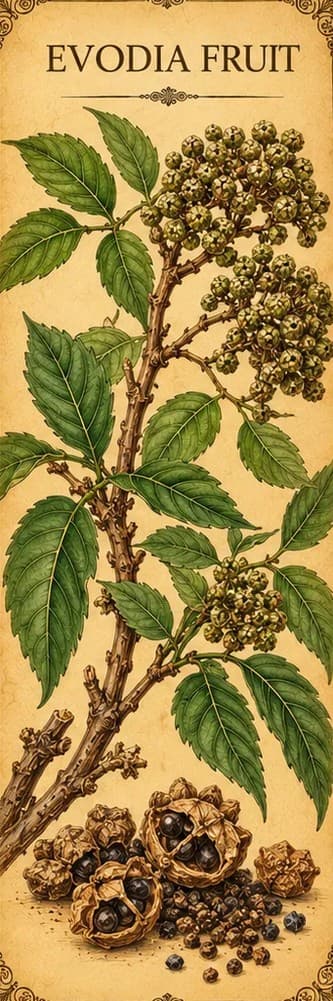
Evodia Fruit
Tetradium ruticarpum
Wu zhu yu, a Chinese medicine fruit used to dispel cold, relieve pain and stop vomiting and diarrhoea, including for headache and period pain. It's mildly toxic and has caused liver damage.
Evodia Fruit may interact with some medicines. If you take any medicine, read Interactions with medicines below and talk to your doctor or pharmacist before using it.
What is Evodia Fruit?
- Plant family
- Rutaceae, the citrus family
- Parts used
- The dried, nearly ripe fruit, often processed to reduce its toxicity
- Genus
- Tetradium
- Species
- ruticarpum
Also called
Euodiae Fructus, Evodia
Traditional names
Wu Zhu Yu, Wuzhuyu
Older scientific names
Evodia rutaecarpa
Traditionally used for
- Headache (traditional)
- Vomiting and stomach pain (traditional)
- Diarrhoea (traditional)
- Period pain (traditional)
Traditionally described as
Health topics
Where Evodia Fruit appears in symptom search, and why. Being listed doesn't mean it's a proven treatment.
- Headache
Used in Chinese formulas for headache. It's mildly toxic and has caused liver damage.
- Liver Safety Warnings
Has caused liver damage in rats and people.
- Occasional Nausea
Traditionally used to stop vomiting. It's mildly toxic and has caused liver damage.
Traditions that use it
Traditional Chinese Medicine
Called wu zhu yu; recorded in the Shennong Herbal Classic and used to dispel cold, relieve pain and stop vomiting and diarrhoea. It's mildly toxic.
Safety
Interactions with medicines
Compounds from the fruit can interact with medicines and cause liver injury.[1]
Toxicity testing
Wu zhu yu is mildly toxic. Too much can cause stomach pain, vomiting and blurred vision. It has caused liver damage in rats and in people, and the heart and kidneys may also be affected. Its main active compounds are also behind its toxicity. Processing reduces it, but toxicity research is limited.[2]
What does the research say?
Traditional use
These are traditional uses, not proven treatments.
Wu zhu yu was first recorded in the Shennong Herbal Classic. It's used to dispel cold and relieve pain, stop vomiting and ease diarrhoea, and in formulas for:
- Headache
- Stomach pain and vomiting
- Diarrhoea and irritable bowel syndrome
- Period pain
- Heavy bleeding after childbirth
Laboratory & animal research
Lab and animal results show what might be worth studying in people. They don't show that the herb has these effects in humans.
In lab and animal studies, wu zhu yu and its compounds (evodiamine and rutaecarpine) slowed tumours, may help reduce inflammation, killed bacteria, reduced obesity, acted as antioxidants, and affected the nervous system and heart. These haven't been confirmed in people.[1]
In short
Mildly toxic: has caused liver damage, and too much can cause vomiting and blurred vision. Can interact with medicines.
Sources
- [1] Traditional uses, phytochemistry, pharmacology, pharmacokinetics and toxicology of the fruit of Tetradium ruticarpum: A review · DOI: 10.1016/j.jep.2020.113231Peer-reviewed study
- [2] Euodiae Fructus: a review of botany, application, processing, phytochemistry, quality control, pharmacology, and toxicology · DOI: 10.3389/fphar.2025.1509032Peer-reviewed study
This information is educational and traditional in nature, and is not a substitute for professional medical advice.