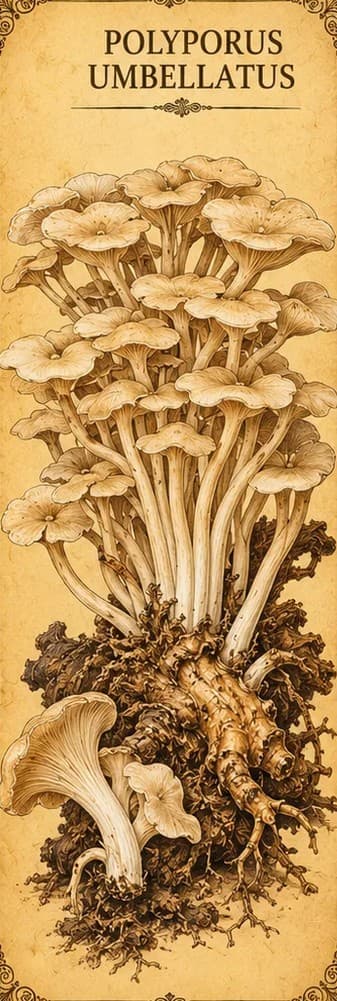
Polyporus Umbellatus
Polyporus umbellatus
Zhu ling, an edible medicinal fungus used in Chinese medicine for swelling, scanty urine, urinary problems, jaundice and diarrhoea. In animal studies it increased urination.
What is Polyporus Umbellatus?
- Plant family
- Polyporaceae, a family of bracket fungi (mushrooms that grow on wood)
- Parts used
- The dried sclerotium, a dark underground mass of the fungus
- Genus
- Polyporus
- Species
- umbellatus
Also called
Polyporus
Traditional names
Zhu Ling, Zhuling
Traditionally used for
- Swelling and scanty urine (traditional)
- Urinary problems (traditional)
- Jaundice and diarrhoea (traditional)
Traditionally described as
- Increased urination (in animal studies)
Traditions that use it
Traditional Chinese Medicine
Called zhu ling; used for swelling (oedema), scanty urine, urinary problems, vaginal discharge, jaundice and diarrhoea.
What does the research say?
Traditional use
These are traditional uses, not proven treatments.
Zhu ling is a medicinal fungus used in Chinese medicine for:
- Swelling from fluid build-up (oedema) and scanty urine
- Urinary problems
- Vaginal discharge
- Jaundice and diarrhoea
Laboratory & animal research
Lab and animal results show what might be worth studying in people. They don't show that the herb has these effects in humans.
In animal studies, zhu ling's main compound ergosterol increased urination and acted on the kidney's water channels. Zhu Ling Tang, a formula that also contains poria, increased urine output in rats with kidney disease.[2]
In lab and animal studies, its extracts and polysaccharides also protected the kidneys and liver, boosted the immune system, slowed cancer cells, may help reduce inflammation and acted as antioxidants. These haven't been confirmed in people.[1]
Its polysaccharides have been studied for about 50 years and are used in functional foods, medicines and cosmetics in China.[3]
Sources
- [1] Traditional uses, phytochemistry, pharmacology, pharmacokinetics and quality control of Polyporus umbellatus (Pers.) Fries: a review · DOI: 10.1016/j.jep.2013.06.031Peer-reviewed study
- [2] Regulation of aquaporin-2 using traditional Chinese medicine in water balance disorders: a literature review · DOI: 10.3389/fcvm.2025.1506190Peer-reviewed study
- [3] A systematic review of advances in preparation, structures, bioactivities, structural-property relationships, and applications of Polyporus umbellatus polysaccharides · DOI: 10.1016/j.fochx.2025.102161Peer-reviewed study
This information is educational and traditional in nature, and is not a substitute for professional medical advice.