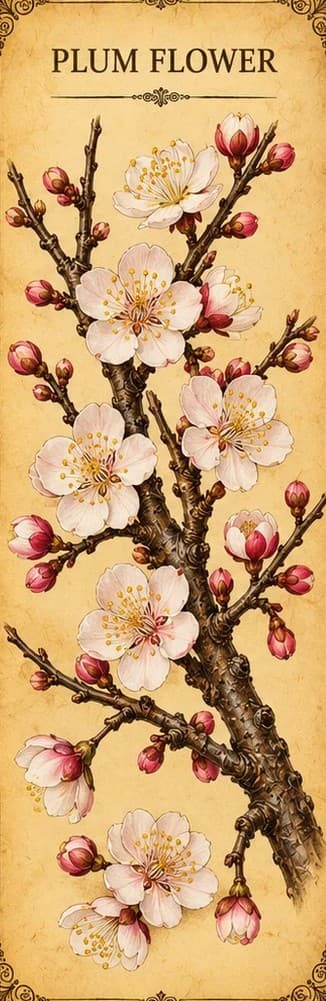
Plum Flower
Prunus mume
The blossom of the Japanese apricot (Prunus mume), an edible flower and herbal medicine (Mume Flos) rich in antioxidants. Research is in the lab and in mice.
What is Plum Flower?
- Plant family
- Rosaceae, the rose family
- Parts used
- The flowers, eaten or used as a herbal medicine (Mume Flos)
- Genus
- Prunus
- Species
- mume
Also called
Mume Flos, Plum Blossom, Japanese Apricot Flower, Prunus mume
Traditional names
Bai Mei Hua, Meihua
Traditionally used for
- Edible flower
- Herbal medicine
Traditionally described as
- Antioxidant (in lab studies)
- Reduced liver fat (in mice)
Health topics
Where Plum Flower appears in symptom search, and why. Being listed doesn't mean it's a proven treatment.
- Fatty Liver (NAFLD)
Reduced fat build-up in the liver in mice on a high-fat diet. Not tested in people.
What does the research say?
Traditional use
These are traditional uses, not proven treatments.
Plum flowers from Prunus mume are eaten as an edible flower in Yunnan, China.[1]
In Chinese medicine, plum flower (bai mei hua) is an ingredient of herbal formulas. For example, it's one of seven herbs in Shen Qing Weichang Formula, a modern formula meant to "regulate qi" and strengthen the spleen, studied for stomach cancer.[2]
Laboratory & animal research
Lab and animal results show what might be worth studying in people. They don't show that the herb has these effects in humans.
In a 2025 analysis of 50 edible flowers from Yunnan, China, plum flowers had the highest polyphenol content and were among the richest in flavonoids, both antioxidants.[1]
In mice fed a high-fat diet, Mume Flos reduced fat build-up in the liver, improved liver tests and inflammation, and eased anxiety-like behaviour while improving learning and memory. This hasn't been tested in people.[3]
In animal research, flavonoids from plum flower had antidepressant-like effects and raised serotonin, and acted as antioxidants that protect nerve cells. Because of this, it was included in a Chinese herbal aromatherapy blend being tested for depression after stroke; that trial's results haven't been published.[4]
In a 2024 lab study, small proteins (polypeptides) from plum blossom protected skin cells from damage caused by UVB light. The study's lead author works for a company, Huzhou Jiahen Industrial.[5]
Sources
- [1] Comprehensive Analysis of 50 Edible Flowers From Yunnan Province: Active Components, Antioxidant Capacity, Tyrosinase Inhibitory Activity and Microbiological Safety · DOI: 10.1002/fsn3.70666Peer-reviewed study
- [2] Integrative network pharmacology, transcriptomics, and proteomics reveal the material basis and mechanism of the Shen Qing Weichang Formula against gastric cancer · DOI: 10.1186/s13020-025-01091-4Peer-reviewed study
- [3] Mume Flos ameliorates MASLD-associated cognitive impairment by attenuating IL-17/NF-κB-mediated metabolic neuroinflammation · DOI: 10.1007/s11011-026-01883-zPeer-reviewed study
- [4] The effect of aromatherapy on post-stroke depression: study protocol for a pilot randomized controlled trial · DOI: 10.3389/fpsyt.2024.1428028Peer-reviewed study
- [5] Plum blossom low molecular weight polypeptide protects HaCaT cells against UVB-induced oxidative damage in vitro and underlying mechanism · DOI: 10.1111/srt.13582Peer-reviewed study
This information is educational and traditional in nature, and is not a substitute for professional medical advice.