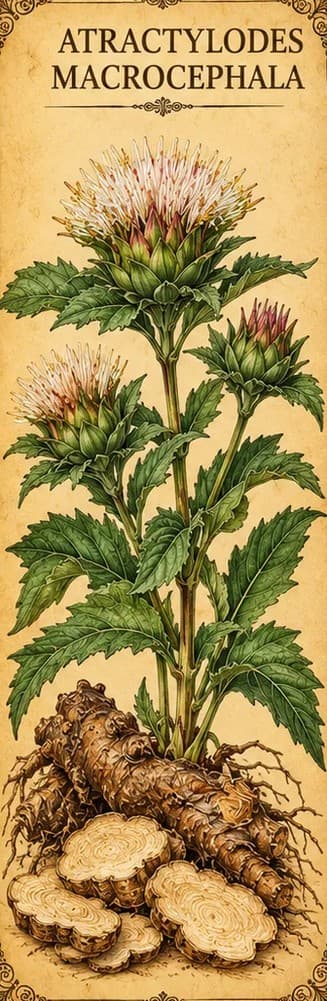
Atractylodes Macrocephala
Atractylodes macrocephala
Bai zhu, a Chinese tonic rhizome for weak digestion and an unsettled pregnancy. Formulas built around it and white peony helped IBS in trials of moderate quality.
What is Atractylodes Macrocephala?
- Plant family
- Asteraceae, the daisy family
- Parts used
- The dried rhizome
- Genus
- Atractylodes
- Species
- macrocephala
Also called
Atractylodes, Atractylodis Macrocephalae Rhizoma
Traditional names
Bai Zhu, Baizhu
Traditionally used for
- Weak digestion (traditional)
- Irritable bowel syndrome (studied in formulas)
- Calming the fetus (traditional)
Traditionally described as
- Improved gut function (in animal studies)
Health topics
Where Atractylodes Macrocephala appears in symptom search, and why. Being listed doesn't mean it's a proven treatment.
- Indigestion
A traditional tonic for weak digestion. Not tested on its own in trials.
- Irritable Bowel Syndrome (IBS)
Formulas built around bai zhu and white peony relieved IBS symptoms in a review of 24 trials; certainty of the evidence wasn't high.
Traditions that use it
Traditional Chinese Medicine
Called bai zhu; a tonic for weak digestion ("spleen deficiency") and for calming the fetus, and a core herb in formulas for irritable bowel.
What does the research say?
Traditional use
These are traditional uses, not proven treatments.
Bai zhu has long been used as a tonic in East Asian medicine, especially in China, for:
- Weak digestion ("spleen deficiency")
- Calming an unsettled fetus in pregnancy
- Bone loss and obesity
Laboratory & animal research
Lab and animal results show what might be worth studying in people. They don't show that the herb has these effects in humans.
In lab and animal studies, its extracts and compounds improved gut function, slowed tumours, may help reduce inflammation, acted as antioxidants, slowed bone loss, protected nerve cells and affected the immune system and hormones. These haven't been confirmed in people.[1]
Research in people
Formulas built around bai zhu and white peony are widely used for irritable bowel syndrome (IBS). A 2023 review of 24 trials with 3,768 people found they relieved IBS symptoms more often than placebo or standard medicines, especially IBS with diarrhoea. About half the trials were at low risk of bias, but overall the certainty of the evidence wasn't high.[2]
Sources
- [1] The traditional uses, phytochemistry, and pharmacology of Atractylodes macrocephala Koidz.: A review · DOI: 10.1016/j.jep.2018.08.023Peer-reviewed study
- [2] Atractylodes macrocephala-Paeonia lactiflora Class Formula for the Treatment of Irritable Bowel Syndrome: A Systematic Review and Meta-Analysis · DOI: 10.7759/cureus.49997Review or clinical trial
This information is educational and traditional in nature, and is not a substitute for professional medical advice.