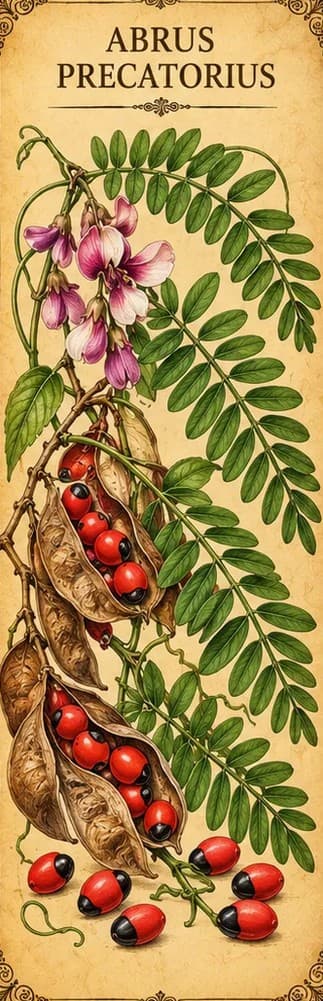
Abrus Precatorius
Abrus precatorius
Rosary pea or jumbee bead, a vine whose leaves are used in traditional medicine. Its bright red-and-black seeds contain abrin, one of the deadliest poisons known.
What is Abrus Precatorius?
- Plant family
- Fabaceae, the pea and bean family
- Parts used
- The leaves are used in traditional medicine; the red-and-black seeds are deadly poisonous
- Genus
- Abrus
- Species
- precatorius
Also called
Rosary Pea, Crab's Eye, Jequirity, Indian Liquorice, Precatory Bean
Regional names
Jumbee Bead, Gunja
Traditionally used for
- Traditional medicine (leaves)
- Joint inflammation (studied only by computer)
Traditionally described as
Health topics
Where Abrus Precatorius appears in symptom search, and why. Being listed doesn't mean it's a proven treatment.
- Joint Discomfort
Warning: the leaves were studied for arthritis only in a computer and chemistry study; the seeds are deadly poisonous.
- Poisonous Plants
The seeds contain abrin, one of the deadliest poisons known.
Safety
Toxicity testing
The seeds contain abrin, one of the deadliest poisons known and considered even more fatal than ricin. Swallowed whole, the hard shell may pass through, but if the seeds are chewed or crushed, as little as 1 or 2 seeds has killed people. Symptoms include vomiting, diarrhoea, stomach pain and bleeding from the gut.[1]
Children are drawn to the brightly coloured seeds and can swallow them by accident.[1]
In St Kitts, jumbee bead was found on almost half the farms surveyed and is known to poison livestock, causing stomach pain, vomiting, bleeding in the gut and nervous system signs.[2]
What does the research say?
Traditional use
These are traditional uses, not proven treatments.
Laboratory & animal research
Lab and animal results show what might be worth studying in people. They don't show that the herb has these effects in humans.
A 2025 computer and chemistry study of the leaves found flavonoids and other compounds predicted to reduce inflammation, suggesting possible use in arthritis. This was not tested in animals or people.[3]
In short
Deadly poisonous seeds: chewing 1 or 2 has killed people, and children are drawn to them.
Sources
- [1] Fatal Curiosity: A Case of Suicidal Attempt by Abrus Seeds Consumption Through Online Research · DOI: 10.7759/cureus.38458Peer-reviewed study
- [2] Toxic Plants Potentially Impacting the Health Status of Livestock in St. Kitts—A Surveillance Study · DOI: 10.3390/toxins18090380Peer-reviewed study
- [3] The potential of Abrus precatorius leaves in arthritis alleviation computational approaches through LC-MS analysis · DOI: 10.1080/20565623.2025.2483131Peer-reviewed study
This information is educational and traditional in nature, and is not a substitute for professional medical advice.