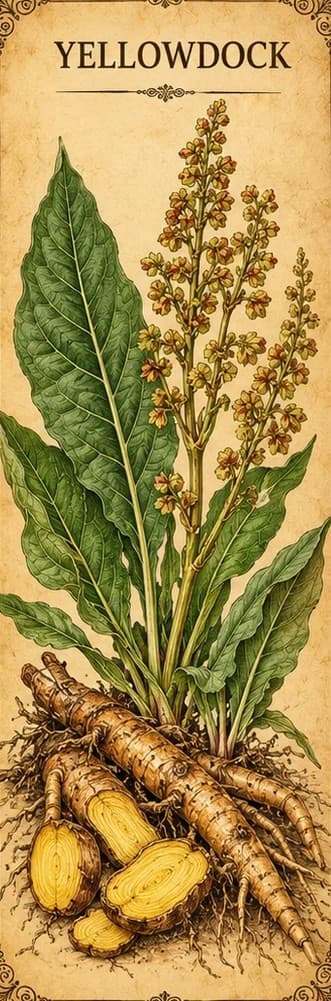
Yellow Dock
Rumex crispus
Curly dock, a plant whose root and leaves are traditional laxatives and tonics, also used for skin problems and jaundice. Research is in the lab and in rats.
What is Yellow Dock?
- Plant family
- Polygonaceae, the buckwheat and dock family
- Parts used
- The roots, leaves and fruit
- Genus
- Rumex
- Species
- crispus
Also called
Yellowdock, Curly Dock, Curled Dock, Rumex crispus
Traditionally used for
- Laxative (traditional)
- Skin disorders (traditional)
- Jaundice (traditional)
- Cancerous sores (traditional Native American use)
Traditionally described as
- Lowered blood sugar (in rats)
- Killed cancer cells (in lab studies)
Health topics
Where Yellow Dock appears in symptom search, and why. Being listed doesn't mean it's a proven treatment.
- Constipation
A traditional laxative. Not tested in trials.
- High Blood Sugar
Lowered blood sugar in diabetic rats. Not tested in people.
Traditions that use it
Native American Ethnobotany
Recorded in Native American medicine for treating cancerous sores.
What does the research say?
Traditional use
These are traditional uses, not proven treatments.
Yellow dock's roots, leaves and fruit have been used in traditional medicine as a tonic and laxative, to reduce fever, to clear phlegm and calm coughs, and to expel worms. They've also been used for:
- Skin disorders
- Jaundice
- Gut problems
- Diabetes
- Eye infections and sexually transmitted infections
Native American medicine recorded its use for cancerous sores. It contains anthraquinones such as emodin, flavonoids and tannins.[2]
Laboratory & animal research
Lab and animal results show what might be worth studying in people. They don't show that the herb has these effects in humans.
In diabetic rats, extracts of the leaves and flowers lowered blood sugar over 30 days, and in the lab they slowed the enzyme that breaks down starch into sugar. This hasn't been tested in people.[1]
In a 2023 lab study, a fraction of a water extract of the leaves killed cancer cells. This hasn't been tested in people.[2]
Sources
- [1] Evaluation of α-Glucosidase Inhibition and Antihyperglycemic Activity of Extracts Obtained from Leaves and Flowers of Rumex crispus L. · DOI: 10.3390/molecules28155760Peer-reviewed study
- [2] Anti-Proliferative and Apoptotic Activities of Rumex crispus · DOI: 10.3390/life14010008Peer-reviewed study
This information is educational and traditional in nature, and is not a substitute for professional medical advice.