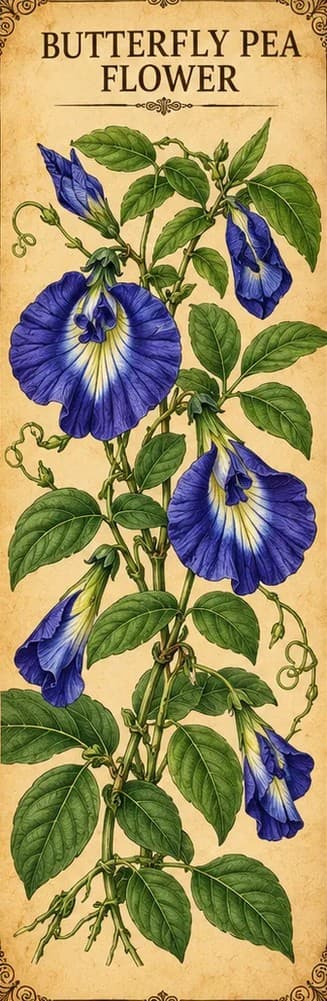
Butterfly Pea Flower
Clitoria ternatea
A vivid blue flower used as a colour-changing tea and food colouring, and traditionally in South Asia to boost memory and for headache and eye infections.
What is Butterfly Pea Flower?
- Plant family
- Fabaceae, the pea and bean family
- Parts used
- The deep blue flowers, usually as tea or a natural food colouring
- Where it grows
- Tropical Asia and Africa
- Genus
- Clitoria
- Species
- ternatea
Also called
Butterfly Pea, Blue Pea, Asian Pigeonwings, Clitoria
Traditionally used for
- Tea and food colouring
- Memory (traditional)
- Eye infections (traditional)
Traditionally described as
- Antioxidant (in lab studies)
Health topics
Where Butterfly Pea Flower appears in symptom search, and why. Being listed doesn't mean it's a proven treatment.
- Memory and Thinking
Traditionally used in South Asia to boost memory and intellect. Not tested in trials.
Traditions that use it
Ayurveda
Used in South Asia to boost memory and intellect and for mental illness, headache and eye infections.
Safety
Toxicity testing
Some studies have reported possible toxic effects from extracts of butterfly pea and a few other edible flowers.[1]
What does the research say?
Traditional use
These are traditional uses, not proven treatments.
Butterfly pea is a climbing vine from tropical Asia and Africa with vivid blue flowers. Traditional uses include:
- South Asia: boosting memory and intellect, mental illness, nerve disorders, eye infections and headache
- Indonesia: eye disease and fever, and cleaning babies' eyes
- India: snakebite and scorpion stings
- Cuba: to bring on periods, as a vaginal wash, and for liver and gut problems
Its flowers are rich in blue anthocyanin pigments, and are used to colour drinks, bread, cakes, noodles and other foods. The colour changes with acidity.[1]
Laboratory & animal research
Lab and animal results show what might be worth studying in people. They don't show that the herb has these effects in humans.
In lab and animal studies, butterfly pea extracts acted as antioxidants, reduced inflammation and pain in rats and mice, and killed several kinds of bacteria. These haven't been confirmed in people.[2]
In short
Some studies report possible toxic effects from extracts.
Sources
- [1] A Comprehensive Review of Edible Flowers with a Focus on Microbiological, Nutritional, and Potential Health Aspects · DOI: 10.3390/foods14101719Peer-reviewed study
- [2] Traditionally Used Edible Flowers as a Source of Neuroactive, Antioxidant, and Anti-Inflammatory Extracts and Bioactive Compounds: A Narrative Review · DOI: 10.3390/molecules30030677Peer-reviewed study
This information is educational and traditional in nature, and is not a substitute for professional medical advice.