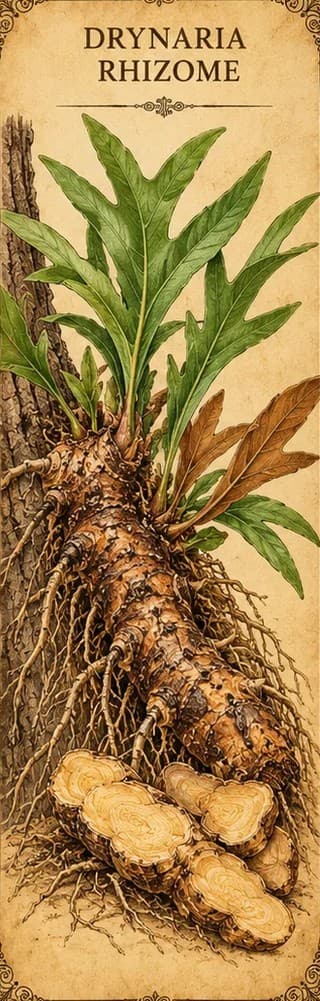
Drynaria Rhizome
Drynaria fortunei
Gu sui bu, the rhizome of a fern used in Chinese medicine to prevent and treat bone diseases such as osteoporosis. In rats it helped bone formation.
What is Drynaria Rhizome?
- Plant family
- Polypodiaceae, the polypody fern family
- Parts used
- The dried rhizome of a fern, usually as a water extract
- Genus
- Drynaria
- Species
- fortunei
Also called
Drynariae Rhizoma, Drynaria
Traditional names
Gu Sui Bu, Gusuibu
Older scientific names
Drynaria roosii
Traditionally used for
- Osteoporosis and bone health (traditional)
Traditionally described as
- Helped bone formation (in animal studies)
Traditions that use it
Traditional Chinese Medicine
Called gu sui bu; commonly used to prevent and treat bone diseases such as osteoporosis.
What does the research say?
Traditional use
These are traditional uses, not proven treatments.
Gu sui bu is the dried rhizome of the fern Drynaria fortunei. In Chinese medicine it's commonly used, usually as a water extract in herbal prescriptions, to prevent and treat bone diseases such as osteoporosis, and it's an ingredient in bone health supplements in China.[1]
Laboratory & animal research
Lab and animal results show what might be worth studying in people. They don't show that the herb has these effects in humans.
In a 2024 study in rats with bone loss like that after menopause, drynaria extract improved bone structure and increased signs of new bone formation, possibly partly through changes in gut bacteria. Earlier lab studies found it helped bone-building cells grow. This hasn't been confirmed in people.[1]
Sources
- [1] Extracts of Drynariae Rhizoma Promote Bone Formation in OVX Rats through Modulating the Gut Microbiota · DOI: 10.1055/a-2462-4844Peer-reviewed study
This information is educational and traditional in nature, and is not a substitute for professional medical advice.