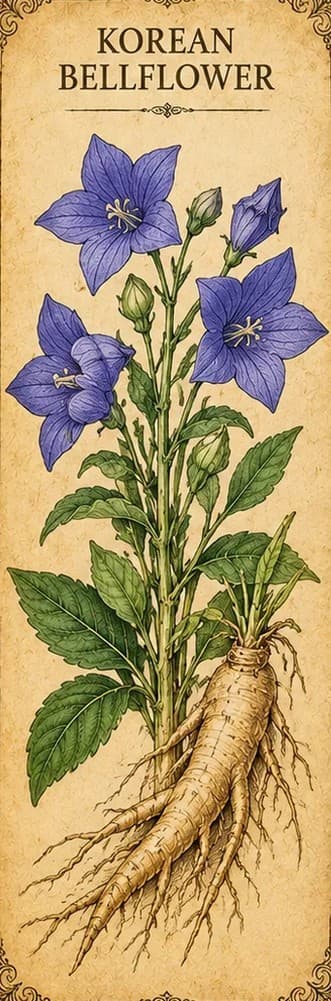
Korean Bellflower
Platycodon grandiflorus
Jie geng or doraji, the root of the balloon flower, eaten as a vegetable and used since the Han Dynasty to clear phlegm, ease sore throats and treat cough.
What is Korean Bellflower?
- Plant family
- Campanulaceae, the bellflower family
- Parts used
- The root, eaten as a vegetable or used as medicine, often honey-processed
- Genus
- Platycodon
- Species
- grandiflorus
Also called
Balloon Flower, Platycodonis Radix, Platycodon
Regional names
Doraji
Traditional names
Jie Geng, Jiegeng
Traditionally used for
- Cough and phlegm (traditional)
- Sore throat (traditional)
- Vegetable
Traditionally described as
- Eased coughs (in animal studies)
Health topics
Where Korean Bellflower appears in symptom search, and why. Being listed doesn't mean it's a proven treatment.
- Cough
A classic Chinese remedy for cough and phlegm; eased coughing in mice. Not tested on its own in trials.
- Sore Throat
Traditionally used for a painful throat. Not tested on its own in trials.
Traditions that use it
Traditional Chinese Medicine
Called jie geng; first recorded in the Shennong Herbal Classic and used to clear phlegm, ease sore throats and treat cough and lung abscesses.
Safety
Contamination
The review notes that its heavy-metal content needs monitoring to make sure it's safe.[1]
What does the research say?
Traditional use
These are traditional uses, not proven treatments.
Jie geng was first recorded in the Shennong Herbal Classic during the Eastern Han Dynasty (25–220 CE) and has been used for centuries as both food and medicine. Classical texts use it to:
- Clear mucus and ease a painful throat
- Treat cough with a full chest
- Treat lung abscesses and coughing up pus, in the classic formula Jie Geng Tang with licorice
It's widely eaten as a vegetable and exported to South Korea, Japan and Southeast Asia.[1]
Laboratory & animal research
Lab and animal results show what might be worth studying in people. They don't show that the herb has these effects in humans.
In lab and animal studies, the root eased coughing and helped clear phlegm (honey processing made the anti-cough effect stronger). It may also help reduce inflammation, affect the immune system, act as an antioxidant, and slow some cancer cells, and it showed anti-obesity and blood-sugar-lowering effects. These haven't been confirmed in people.[1]
Sources
- [1] Ethnopharmacology, phytochemistry, pharmacology and product application of Platycodon grandiflorum: A review · DOI: 10.1016/j.chmed.2024.01.005Peer-reviewed study
This information is educational and traditional in nature, and is not a substitute for professional medical advice.