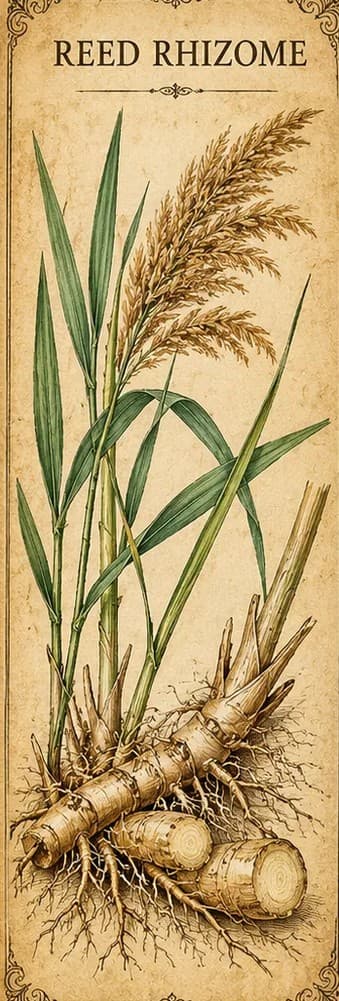
Reed Rhizome
Phragmites australis
Lu gen, the underground stem of the common reed, used in Chinese medicine to clear heat and increase urination, for fever, nausea and urinary problems.
What is Reed Rhizome?
- Plant family
- Poaceae, the grass family
- Parts used
- The fresh or dried underground stem (rhizome)
- Where it grows
- Worldwide, on the banks of rivers, lakes and ponds and in low wetlands
- Genus
- Phragmites
- Species
- australis
Also called
Reed Root, Phragmitis Rhizoma, Common Reed
Traditional names
Lu Gen, Lugen
Older scientific names
Phragmites communis
Traditionally used for
- Fever (traditional)
- Nausea (traditional)
- Urinary problems (traditional)
Traditionally described as
- Lowered uric acid (in animal studies)
Health topics
Where Reed Rhizome appears in symptom search, and why. Being listed doesn't mean it's a proven treatment.
- Fever
A traditional Chinese remedy for fever. Not tested in trials.
- Occasional Nausea
Traditionally prescribed for nausea. Not tested in trials.
Traditions that use it
Traditional Chinese Medicine
Called lu gen; used to "clear heat" and increase urination, for fever, nausea and urinary problems.
What does the research say?
Traditional use
These are traditional uses, not proven treatments.
Lu gen is the fresh or dried underground stem of the common reed, which grows worldwide on riverbanks and in wetlands. In Chinese medicine it's used to "clear heat" and increase urination, and has been prescribed for fever, nausea and urinary problems.[1]
Chinese medical texts also record its use for conditions like diabetes.[2]
Laboratory & animal research
Lab and animal results show what might be worth studying in people. They don't show that the herb has these effects in humans.
In a 2026 lab and animal study, a reed rhizome extract lowered high uric acid levels (linked to gout) by blocking the enzyme that makes uric acid and helping the kidneys and gut clear it. It also reduced inflammation and helped the gut lining. This hasn't been tested in people.[1]
In lab tests, a polysaccharide from the rhizome slowed the breakdown of starch into sugar and helped insulin-resistant liver cells take up sugar.[2]
Sources
- [1] Phragmites Communis (Lu Gen) Alleviates Hyperuricemia via Xanthine Oxidase Inhibition and Gut-Microbiota-Mediated Metabolite Urate Transporter Regulation · DOI: 10.3390/ph19091474Peer-reviewed study
- [2] The physiochemical characteristics of Phragmites communis trin polysaccharides and in vitro anti-diabetic effects of their different fractions · DOI: 10.3389/fphar.2026.1727657Peer-reviewed study
This information is educational and traditional in nature, and is not a substitute for professional medical advice.