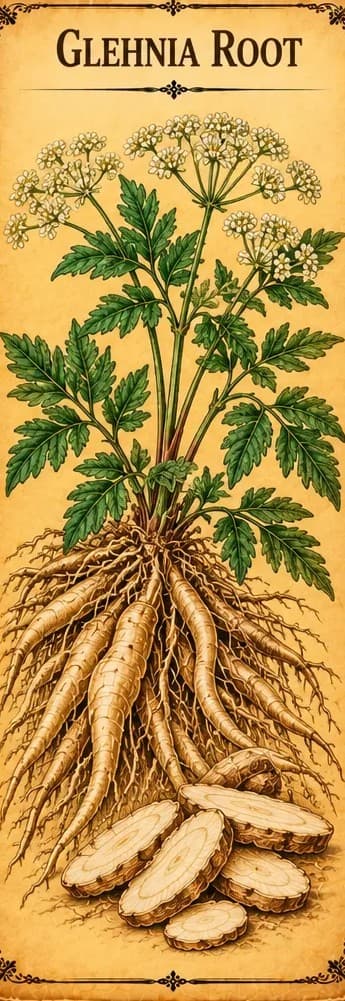
Glehnia Root
Glehnia littoralis
Bei sha shen, a root recorded in the Shennong Herbal Classic and used to clear the lungs, ease dry cough and dry mouth, and help the stomach.
What is Glehnia Root?
- Plant family
- Apiaceae, the carrot and parsley family
- Parts used
- The dried root, harvested in summer and autumn
- Genus
- Glehnia
- Species
- littoralis
Also called
Glehniae Radix, Glehnia
Traditional names
Bei Sha Shen, Beishashen
Traditionally used for
- Dry cough (traditional)
- Dry mouth and sore throat (traditional)
- Poor appetite (traditional)
Traditionally described as
- Affected the immune system (in lab studies)
Health topics
Where Glehnia Root appears in symptom search, and why. Being listed doesn't mean it's a proven treatment.
- Cough
Used in Chinese lung-clearing and cough medicines. Not tested on its own in trials.
- Sore Throat
Used in traditional formulas for sore throat and dry mouth. Not tested on its own in trials.
Traditions that use it
Traditional Chinese Medicine
Called bei sha shen; recorded in the Shennong Herbal Classic and used to nourish yin, clear the lungs and help the stomach.
What does the research say?
Traditional use
These are traditional uses, not proven treatments.
Glehnia root, bei sha shen in Chinese, was first recorded in the Shennong Herbal Classic. It's described as sweet, bitter and slightly cold, and is used to nourish yin, "clear the lungs", help the stomach and promote body fluids. It's mainly grown in coastal areas. It's in 126 Chinese patent medicines, including lung-clearing and cough capsules, and in formulas for dry mouth, sore throat and poor appetite.[1]
Laboratory & animal research
Lab and animal results show what might be worth studying in people. They don't show that the herb has these effects in humans.
In lab and animal studies, polysaccharides from the root affected the immune system, slowed tumours and acted as antioxidants. They haven't been tested on their own in people.[1]
Sources
- [1] Extraction, Purification, Structure, and Bioactivities of Polysaccharides from Glehnia littoralis: A Review · DOI: 10.3390/molecules30214173Peer-reviewed study
This information is educational and traditional in nature, and is not a substitute for professional medical advice.