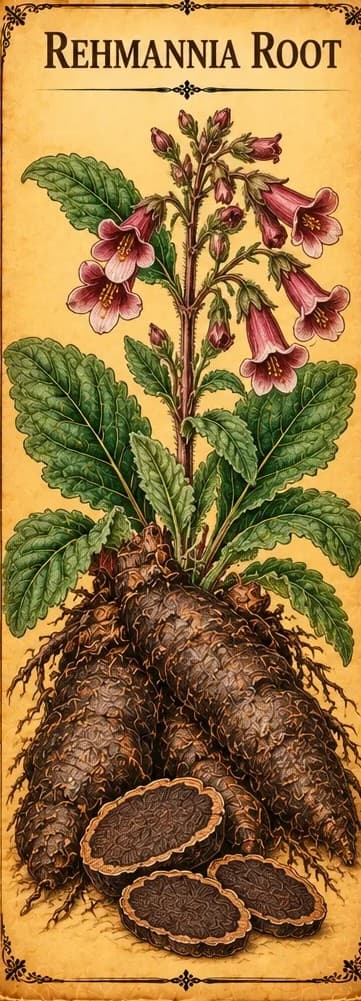
Rehmannia Root
Rehmannia glutinosa
Di huang, a Chinese medicine root used raw or steamed black, recorded in the Shennong Herbal Classic for injuries, joint pain and as a "kidney" tonic. Research is in the lab and in animals.
What is Rehmannia Root?
- Plant family
- Orobanchaceae, the broomrape family
- Parts used
- The root, used raw (sheng di huang) or steamed until black (shu di huang)
- Genus
- Rehmannia
- Species
- glutinosa
Also called
Rehmanniae Radix, Rehmannia
Traditional names
Di Huang, Shu Di Huang, Sheng Di Huang
Traditionally used for
- Kidney tonic (traditional)
- Injuries and joint pain (traditional)
- Anti-ageing (traditional)
Traditionally described as
- Protected the kidneys (in animal studies)
Traditions that use it
Traditional Chinese Medicine
Called di huang; recorded in the Shennong Herbal Classic and used for centuries to strengthen the "kidneys" and treat kidney diseases.
Safety
Toxicity testing
Its long traditional use suggests it's safe, but full toxicity studies of its purified extracts are largely missing.[1]
What does the research say?
Traditional use
These are traditional uses, not proven treatments.
The Shennong Herbal Classic describes rehmannia as sweet, cold and non-toxic, and recommends it for:
- Broken bones and muscle injuries
- "Blood stasis"
- Building up bone marrow and muscle
- Aching joints
It says that taken long-term, it "lightens the body" and slows ageing. Chinese medicine has long used it to strengthen the "kidneys", a term that also covers growth, reproduction and fluid balance.[2]
The root is used raw (sheng di huang) or steamed (shu di huang), and steaming changes its chemistry and effects.[1]
Laboratory & animal research
Lab and animal results show what might be worth studying in people. They don't show that the herb has these effects in humans.
In lab and animal studies, compounds from rehmannia, such as catalpol, protected the kidneys and reduced kidney scarring. These haven't been confirmed in people.[2]
In lab and animal studies, rehmannia polysaccharides boosted the immune system and slowed some lung cancer cells. These haven't been tested in people.[1]
In short
Full toxicity studies of its extracts are lacking.
Sources
- [1] Rehmannia glutinosa polysaccharides: a review on structural features, pharmacological potential, and advanced delivery systems · DOI: 10.3389/fnut.2026.1772902Peer-reviewed study
- [2] Harnessing the multi-targeted potential of rehmanniae radix natural products against renal fibrosis: a mechanistic review · DOI: 10.3389/fphar.2025.1690036Peer-reviewed study
This information is educational and traditional in nature, and is not a substitute for professional medical advice.