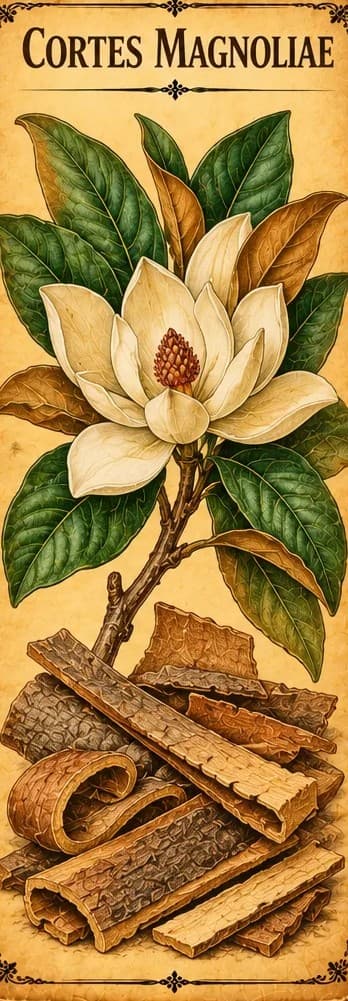
Magnolia Bark
Magnolia officinalis
Hou po, the bark of a magnolia tree used in Chinese medicine to ease bloating, stomach pain, diarrhoea and asthma, often paired with coptis root.
What is Magnolia Bark?
- Plant family
- Magnoliaceae, the magnolia family
- Parts used
- The dried bark of the stem, root or branches
- Genus
- Magnolia
- Species
- officinalis
Also called
Cortex Magnoliae, Cortes Magnoliae, Magnoliae Officinalis Cortex
Traditional names
Hou Po, Houpo
Traditionally used for
- Bloating and stomach pain (traditional)
- Diarrhoea (traditional)
- Asthma (traditional)
Traditionally described as
- Killed bacteria (in lab studies)
Health topics
Where Magnolia Bark appears in symptom search, and why. Being listed doesn't mean it's a proven treatment.
- Asthma and Wheezing
Traditionally used to ease asthma. Not tested in trials.
- Bloating
A traditional Chinese remedy for bloating and stomach pain, often with coptis. Not tested on its own in trials.
- Diarrhea
Used with coptis for "damp-heat" diarrhoea and dysentery; reduced diarrhoea in mice. Not tested in trials.
Traditions that use it
Traditional Chinese Medicine
Called hou po; used to move qi, "dry dampness" and ease breathing, and with huang lian (coptis) for dysentery, bloating and stomach pain.
Safety
What does the research say?
Traditional use
These are traditional uses, not proven treatments.
Magnolia bark, hou po in Chinese, is described as bitter, pungent and warm. It's used to "move qi", "dry dampness", settle "rising qi" and ease asthma. It's often paired with huang lian (coptis root) in classic formulas for:
- Dysentery and "damp-heat" diarrhoea
- Bloating
- Stomach pain
Magnolia bark has been used in Chinese and Japanese medicine, and its extract is now used in dietary supplements and cosmetics.[1]
Laboratory & animal research
Lab and animal results show what might be worth studying in people. They don't show that the herb has these effects in humans.
In lab and animal studies, magnolia bark killed bacteria, slowed tumours, relieved pain, may help reduce inflammation and acted as an antioxidant. With coptis, it reduced diarrhoea and pain in mice.[3]
In short
No harm seen in a 90-day rat study.
Sources
- [1] Evaluation of short-term and subchronic toxicity of magnolia bark extract in rats · DOI: 10.1016/j.yrtph.2007.06.006Peer-reviewed study
- [2] Evaluation of the in vitro and in vivo genotoxicity of magnolia bark extract · DOI: 10.1016/j.yrtph.2007.06.005Peer-reviewed study
- [3] A Comprehensive Review of Coptidis Rhizoma and Magnoliae Officinalis Cortex Drug Pair and Their Chemical Composition, Pharmacological Effects and Pharmacokinetics Analysis · DOI: 10.2147/DDDT.S477381Peer-reviewed study
This information is educational and traditional in nature, and is not a substitute for professional medical advice.