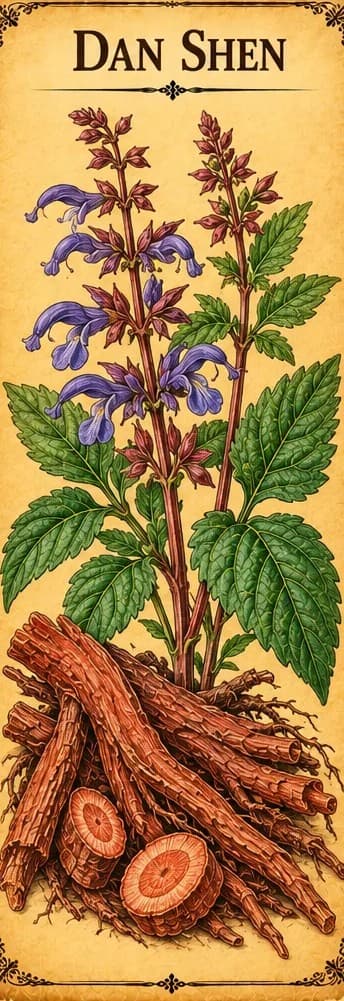
Dan Shen
Salvia miltiorrhiza
The root of Salvia miltiorrhiza, widely used in Chinese medicine for the heart and circulation. Small trials suggest possible heart benefits, but it raises bleeding risk with blood thinners.
Dan Shen may interact with some medicines. If you take any medicine, read Interactions with medicines below and talk to your doctor or pharmacist before using it.
What is Dan Shen?
- Plant family
- Lamiaceae, the mint family
- Parts used
- The red roots
- Genus
- Salvia
- Species
- miltiorrhiza
Also called
Salvia miltiorrhiza
Traditional names
Danshen
Traditionally used for
- Heart and circulation (traditional)
- Coronary artery disease (studied)
Traditionally described as
- Reduced blood clotting (in lab studies)
Health topics
Where Dan Shen appears in symptom search, and why. Being listed doesn't mean it's a proven treatment.
- Poor Circulation
Widely used in Chinese medicine for the heart and circulation; trials are small. Raises bleeding risk with blood thinners.
Traditions that use it
Traditional Chinese Medicine
Called dan shen; the root is widely used in Chinese medicine, especially for the heart and circulation.
Safety
Interactions with medicines
Dan shen raises the risk of bleeding with blood thinners. In a 2026 study of 525 people in Taiwan taking oral anticoagulants, the risk of any bleeding was about 4 times higher in the first 4 weeks after dan shen was added, including bleeding in the gut and the brain. In the lab, it slows the breakdown of warfarin and newer blood thinners such as rivaroxaban and apixaban.[1]
Technical detail: any bleeding aIRR 3.98 (95% CI 3.29–4.77) on days 1–14 and 3.99 (3.23–4.79) on days 15–28.
Side effects
Side effects are rare but can include mild stomach upset and allergic reactions. Too much may be toxic, and it can affect how the liver breaks down some medicines.[2]
What does the research say?
Traditional use
These are traditional uses, not proven treatments.
Dan shen is a widely used Chinese medicinal herb, and its roots are the main part used for the heart and blood vessels. It's taken as the crude root and in preparations such as Compound Danshen Dripping Pills and injections.[2]
Laboratory & animal research
Lab and animal results show what might be worth studying in people. They don't show that the herb has these effects in humans.
In lab and animal studies, its compounds (tanshinones and salvianolic acids) acted as antioxidants, may help reduce inflammation, relaxed blood vessels, reduced blood clotting and scarring, and protected the heart during reduced blood flow.[2]
Research in people
Clinical studies suggest possible benefits in coronary artery disease and reduced blood flow to the heart. But the trials were small and varied in the products and doses used, so high-quality trials are still needed.[2]
In short
About 4 times the bleeding risk when taken with blood thinners such as warfarin.
Sources
- [1] Increasing risk of hemorrhage following concurrent use of Salvia miltiorrhiza and oral anticoagulants · DOI: 10.1177/20420986261446497Peer-reviewed study
- [2] Cardiovascular Benefits of Salvia miltiorrhiza (Danshen) Supplementation: Bioactive Constituents, Mechanisms, Clinical Evidence, and Formulation Strategies · DOI: 10.1002/fsn3.71755Peer-reviewed study
This information is educational and traditional in nature, and is not a substitute for professional medical advice.