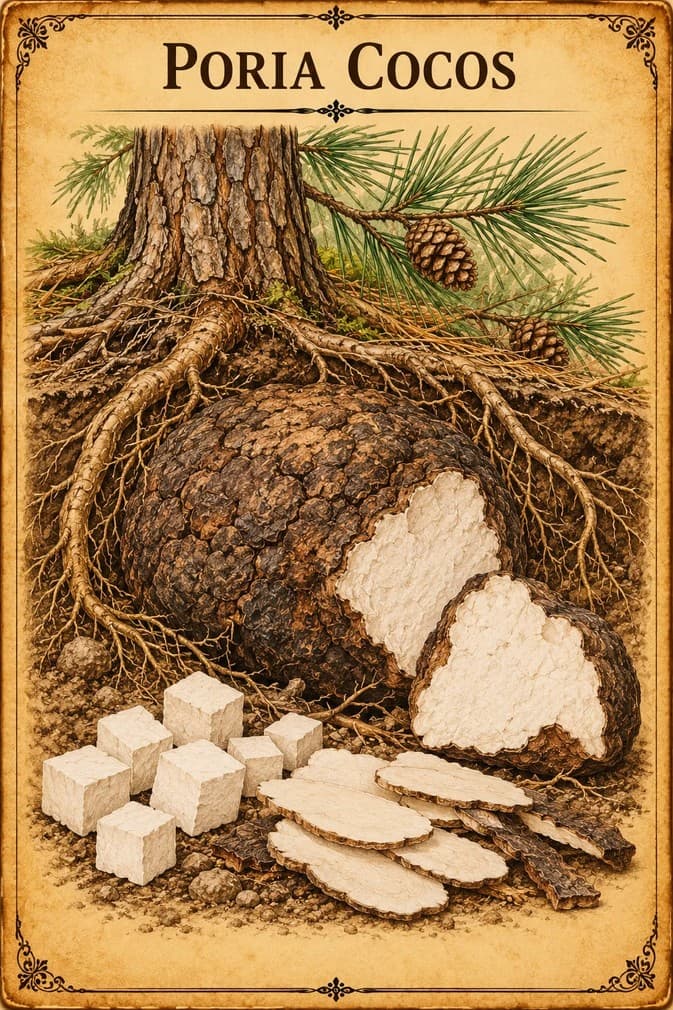
Poria Cocos
Wolfiporia cocos
Fu ling, an edible fungus used in Chinese medicine for over 2,000 years to promote urination, reduce swelling, aid digestion and calm the mind. It's in nearly 15% of Chinese Pharmacopoeia preparations.
What is Poria Cocos?
- Plant family
- Polyporaceae, a family of bracket fungi (mushrooms that grow on wood)
- Parts used
- The dried sclerotium, a firm underground mass of the fungus, usually cut into white cubes or slices
- Genus
- Wolfiporia
- Species
- cocos
Also called
Poria, Wolfiporia cocos
Traditional names
Fu Ling, Fuling
Older scientific names
Poria cocos
Traditionally used for
- Swelling and urination (traditional)
- Digestion (traditional)
- Calming the mind (traditional)
- Type 2 diabetes (in formulas
- studied)
Traditionally described as
- Protected the liver and kidneys (in animal studies)
Health topics
Where Poria Cocos appears in symptom search, and why. Being listed doesn't mean it's a proven treatment.
- High Blood Sugar
Formulas containing fu ling, added to diabetes medicines, lowered blood sugar in low-to-moderate quality Chinese trials.
- Sleep Problems (Insomnia)
Traditionally used to calm the mind. Not tested on its own in trials.
Traditions that use it
Traditional Chinese Medicine
Called fu ling; recorded in the Shennong Herbal Classic and used for over 2,000 years to promote urination, "remove dampness", strengthen the spleen and calm the mind.
Safety
Side effects
In the diabetes trials, side effects were no more common when formulas containing fu ling were added to diabetes medicines.[1]
Toxicity testing
Poria has low toxicity in mice, and no problems were reported with traditional doses of 6 to 18 g a day.[2]
What does the research say?
Traditional use
These are traditional uses, not proven treatments.
Poria is an edible medicinal fungus, called fu ling in Chinese. It was first recorded in the Shennong Herbal Classic and has been used for over 2,000 years. It's used to:
- Promote urination and "remove dampness"
- Reduce swelling (oedema) and phlegm
- Strengthen the spleen and help digestion
- Calm the mind
It's one of the most important Chinese medicines: nearly 15% of the preparations in the Chinese Pharmacopoeia contain it, including classic formulas such as Wu Ling San and Gui Zhi Fu Ling Wan.[2]
Laboratory & animal research
Lab and animal results show what might be worth studying in people. They don't show that the herb has these effects in humans.
In lab and animal studies, compounds from poria (triterpenes and polysaccharides) slowed tumours and killed microbes, acted as antioxidants, may help reduce inflammation, affected the immune system, and protected the liver and kidneys. These haven't been confirmed in people.[2]
Research in people
Fu ling is one of the herbs most often prescribed in China for type 2 diabetes. A 2022 review of 73 Chinese trials with 6,489 people found that adding herbal formulas containing it to diabetes medicines lowered fasting and after-meal blood sugar and HbA1c. Most trials were at risk of bias, and the strength of evidence was low to moderate. The formulas contained other herbs too, so the effect of poria alone isn't known.[1]
Technical detail: fasting glucose MD −0.82 mmol/L (−0.93 to −0.71); HbA1c MD −0.64% (−0.75 to −0.53).
In short
Low toxicity in animal studies.
Sources
- [1] Benefits of herbal formulae containing Poria cocos (Fuling) for type 2 diabetes mellitus: A systematic review and meta-analysis · DOI: 10.1371/journal.pone.0278536Review or clinical trial
- [2] Phytochemistry and Pharmacological Activities of Wolfiporia cocos (F.A. Wolf) Ryvarden & Gilb. · DOI: 10.3389/fphar.2020.505249Peer-reviewed study
This information is educational and traditional in nature, and is not a substitute for professional medical advice.