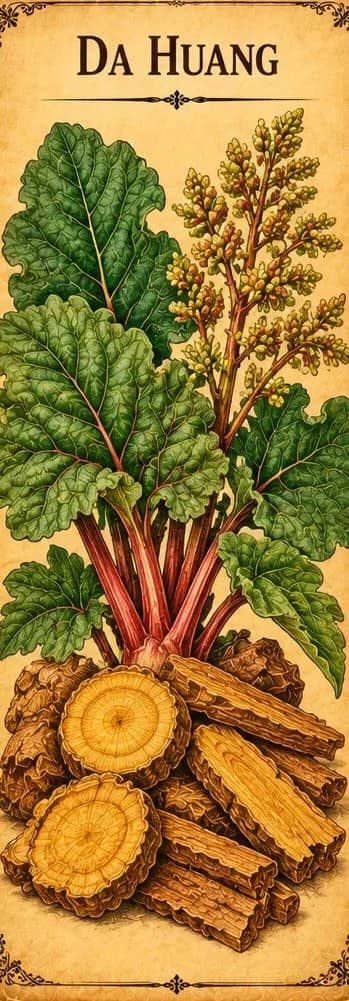
Da Huang
Rheum palmatum
Chinese rhubarb root, a Chinese medicine used for thousands of years as a purgative, and accepted in the EU as a stimulant laxative for occasional constipation, for no more than a week.
Da Huang may interact with some medicines. If you take any medicine, read Interactions with medicines below and talk to your doctor or pharmacist before using it.
What is Da Huang?
- Plant family
- Polygonaceae, the buckwheat and dock family
- Parts used
- The dried root and rhizome
- Genus
- Rheum
- Species
- palmatum
Also called
Rhubarb Root, Chinese Rhubarb, Rhei Radix et Rhizoma
Traditional names
Dahuang
Older scientific names
Rheum officinale
Traditionally used for
- Occasional constipation
- Clearing heat (traditional)
- Blood stasis (traditional)
Traditionally described as
- Stimulant laxative
Health topics
Where Da Huang appears in symptom search, and why. Being listed doesn't mean it's a proven treatment.
- Constipation
Accepted by the European Medicines Agency for short-term use in occasional constipation; not for more than 1 week.
Traditions that use it
Traditional Chinese Medicine
Called da huang; used for thousands of years as a purgative to "clear heat", and to restore menstruation and relieve "blood stasis".
Safety
Interactions with medicines
Long-term use can lower potassium, which can increase the effect of heart medicines such as cardiac glycosides and interact with heart-rhythm medicines. People taking these, medicines that lengthen the QT interval, water pills, corticosteroids or liquorice root should ask a doctor before using it.[1]
Who should avoid it
Don't use rhubarb root if you have:
- A blocked or narrowed bowel, or a bowel that doesn't move
- Appendicitis
- Inflammatory bowel disease such as Crohn's disease or ulcerative colitis
- Stomach pain without a known cause
- Severe dehydration
It's not for children under 12, or during pregnancy or breastfeeding.[1]
Side effects
It can cause stomach cramps and watery stools, and allergic reactions such as itching, hives or rash. Long-term use can make the bowel work less well and lead to laxative dependence, and can cause loss of water and salts and protein or blood in the urine. It can turn urine yellow or red-brown, which is harmless. Long-term overdose can cause liver inflammation.[1]
Long-term use of herbs like da huang is linked to melanosis coli, a brown discolouring of the bowel lining. It isn't cancerous and can go away, but people with it have a higher rate of bowel polyps. The reviewers advise against long-term use in large doses.[2]
Toxicity testing
In 2024, the European Food Safety Authority said it couldn't establish the safety of rhubarb root preparations in foods and supplements, because they contain compounds known or suspected to damage DNA.[3]
What does the research say?
Traditional use
These are traditional uses, not proven treatments.
Da huang has been used in Chinese medicine for thousands of years. It's used to:
- Loosen the bowels and "clear heat"
- Remove "heat" and "toxins" from the blood
- Relieve "blood stasis" and restore menstruation
It's an ingredient in many Chinese formulas and is commonly used as a laxative in both traditional and modern medicine.[2]
Research in people
The European Medicines Agency accepts rhubarb root as an established medicine for short-term use in occasional constipation. It's a stimulant laxative: bacteria in the large intestine turn its compounds into active forms that make the bowel move.
- Taken once a day at night, at the smallest dose that gives a soft stool
- Not to be used for more than 1 week, and usually only 2 or 3 times in that week
Technical detail: dose equivalent to 20–30 mg hydroxyanthracene derivatives (as rhein) once daily; for adolescents over 12, adults and the elderly.
In short
Not for more than 1 week, for children under 12, or in pregnancy or breastfeeding. Long-term use can cause laxative dependence and potassium loss.
Sources
- [1] European Union herbal monograph on Rheum palmatum L. and Rheum officinale Baillon, radix, Final – Revision 1 (EMA/HMPC/113700/2019) — European Medicines Agency, Committee on Herbal Medicinal Products (HMPC)Government health agency
- [2] Review on melanosis coli and anthraquinone-containing traditional Chinese herbs that cause melanosis coli · DOI: 10.3389/fphar.2023.1160480Peer-reviewed study
- [3] Scientific Opinion on additional scientific data related to the safety of preparations of Rheum palmatum L., Rheum officinale Baill. and their hybrids, Rhamnus purshiana DC., Rhamnus frangula L. and Cassia senna L. — European Food Safety Authority, Panel on Nutrition, Novel Foods and Food Allergens (NDA) · DOI: 10.2903/j.efsa.2024.8766Government health agency
This information is educational and traditional in nature, and is not a substitute for professional medical advice.