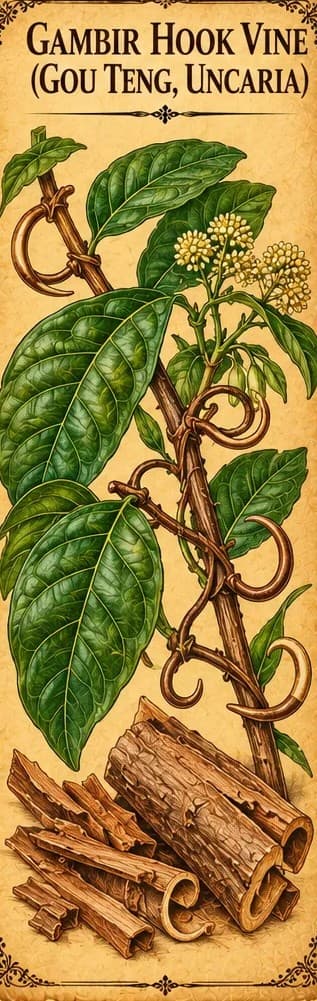
Gambir Hook Vine
Uncaria rhynchophylla
Gou teng, the hooked stems of a climbing shrub used in Chinese medicine for over 1,500 years for convulsions, tremors, and high blood pressure with headache and dizziness.
What is Gambir Hook Vine?
- Plant family
- Rubiaceae, the coffee family
- Parts used
- The hooked stems (hooks), dried and added to decoctions
- Genus
- Uncaria
- Species
- rhynchophylla
Also called
Uncaria, Uncariae Ramulus cum Uncis
Traditional names
Gou Teng, Gouteng
Traditionally used for
- High blood pressure (traditional)
- Convulsions and tremors (traditional)
- Headache and dizziness (traditional)
Traditionally described as
- Lowered blood pressure (in animal studies)
Health topics
Where Gambir Hook Vine appears in symptom search, and why. Being listed doesn't mean it's a proven treatment.
- Headache
Traditionally used for headache and dizziness linked to high blood pressure. Not well tested in trials.
- High Blood Pressure
A traditional Chinese herb for high blood pressure with headache and dizziness; lowered blood pressure in animal studies. Clinical evidence is limited.
Traditions that use it
Traditional Chinese Medicine
Called gou teng; used for over 1,500 years to "extinguish wind" and "calm liver yang": for convulsions, tremors, high blood pressure, headache and dizziness.
Safety
How much to use
No toxicity has been reported at traditional doses of 3 to 12 g a day, but too much may cause dizziness or drowsiness.[1]
What does the research say?
Traditional use
These are traditional uses, not proven treatments.
Gou teng is a climbing shrub that has been used in Chinese medicine for over 1,500 years, and China still uses over 5,000 tons a year. It's used to "extinguish wind and stop spasms" and to "calm liver yang", mainly for:
- Convulsions in children, epilepsy and tremors
- High blood pressure, with headache, dizziness and ringing in the ears
The hooks are traditionally added to a boiling decoction only for the last 5 to 10 minutes, because long boiling breaks down its main compounds.[1]
Laboratory & animal research
Lab and animal results show what might be worth studying in people. They don't show that the herb has these effects in humans.
In lab and animal studies, its alkaloids (such as rhynchophylline) protected nerve cells, lowered blood pressure by relaxing blood vessels, and may help reduce inflammation.[1]
Research in people
Clinical studies are limited to small studies in Asia. The reviewers say larger, standardised trials are needed to show whether it works and is safe.[1]
In short
Too much may cause dizziness or drowsiness. Clinical evidence is limited.
Sources
- [1] Uncaria rhynchophylla: an ethnopharmacological review integrating traditional Chinese medicine uses with phytochemical and pharmacological evidence · DOI: 10.3389/fphar.2026.1723499Peer-reviewed study
This information is educational and traditional in nature, and is not a substitute for professional medical advice.