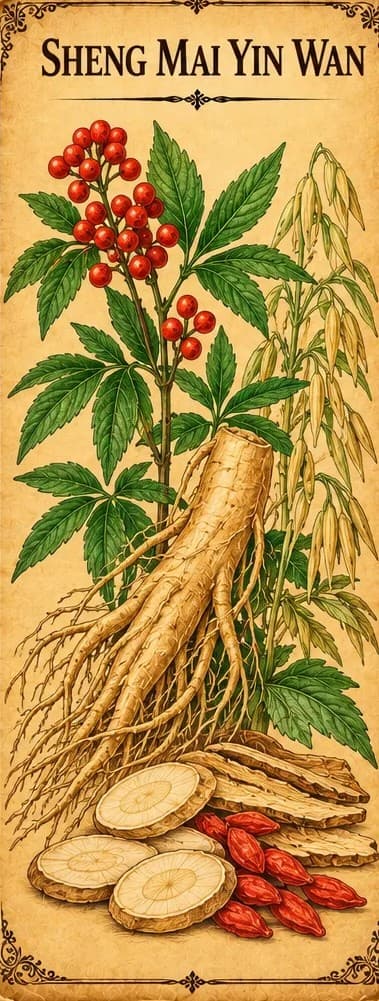
Sheng Mai Yin Wan
Panax ginseng, Ophiopogon japonicus, Schisandra chinensis
A classical Chinese formula of ginseng, ophiopogon and schisandra, used for about 1,000 years to "supplement qi and yin" and for heart symptoms. Low-quality trials in viral myocarditis suggest possible benefit.
What is Sheng Mai Yin Wan?
- Plant family
- Araliaceae (the ginseng family) for ginseng; Asparagaceae (the asparagus family) for ophiopogon; Schisandraceae (the magnolia-vine family) for schisandra
- Parts used
- A formula of three herbs: ginseng root, ophiopogon root and schisandra fruit, as pills, decoctions or patent medicines
- Genus
- Panax / Ophiopogon / Schisandra
- Species
- ginseng / japonicus / chinensis
Traditional names
Shengmai San, Sheng Mai San, Shengmai Yin, Sheng Mai Yin
Traditionally used for
- Palpitations and heart symptoms (traditional)
- Viral myocarditis (studied)
Traditionally described as
Health topics
Where Sheng Mai Yin Wan appears in symptom search, and why. Being listed doesn't mean it's a proven treatment.
- Heart Palpitations
Low-quality Chinese trials in viral myocarditis linked it to faster recovery from palpitations; the benefit is uncertain.
- Low Blood Pressure
Given by injection, the formula reduced drops in blood pressure during kidney dialysis in poor-quality trials. Not tested as pills.
Traditions that use it
Traditional Chinese Medicine
A classical formula first recorded about 1,000 years ago, used to "supplement qi and yin" and for heart symptoms such as palpitations.
Safety
Side effects
No serious side effects were reported in 44 trials of sheng mai for viral myocarditis.[1]
What does the research say?
Traditional use
These are traditional uses, not proven treatments.
Sheng mai is a classical Chinese formula first written down about 1,000 years ago by Zhang Yuansu in the Jin Dynasty. It combines three herbs:
- Ginseng root (renshen); today dangshen or taizishen are sometimes used instead
- Ophiopogon root (maidong)
- Schisandra fruit (wuweizi)
It's used to "supplement qi and yin", and to ease symptoms linked to irregular heartbeat and heart failure.[1]
Research in people
A 2024 review combined 44 Chinese trials with 4,298 people with viral myocarditis (heart inflammation caused by a virus). Sheng mai, alone or with standard treatment, was linked to more people recovering from palpitations, chest pain and breathlessness, and to better heart tests. But the trials were of low quality and none used a placebo, so the benefit is uncertain. No serious side effects were reported.[1]
Shengmai injection is the same three-herb formula given into a vein in Chinese hospitals. A 2013 review of 10 trials with 437 people found that adding it to usual care during kidney dialysis meant fewer episodes of blood pressure dropping too low and fewer times nurses had to step in. The lower (diastolic) blood pressure number rose, but the upper (systolic) number didn't change significantly. No serious side effects were reported, but all the trials were of poor quality, so better trials are needed. These results are for the injection, not the pills.[2]
Technical detail: intradialytic hypotension; mean arterial pressure P = 0.22; systolic P = 0.08.
In short
Trials were low quality; no serious side effects were reported.
Sources
- [1] Effectiveness and Safety of Shengmai San for Viral Myocarditis: A Systematic Review and Meta-Analysis of Randomized Controlled Trials · DOI: 10.1155/2024/2127018Review or clinical trial
- [2] Shengmai injection, a traditional chinese patent medicine, for intradialytic hypotension: a systematic review and meta-analysis · DOI: 10.1155/2013/703815Review or clinical trial
This information is educational and traditional in nature, and is not a substitute for professional medical advice.