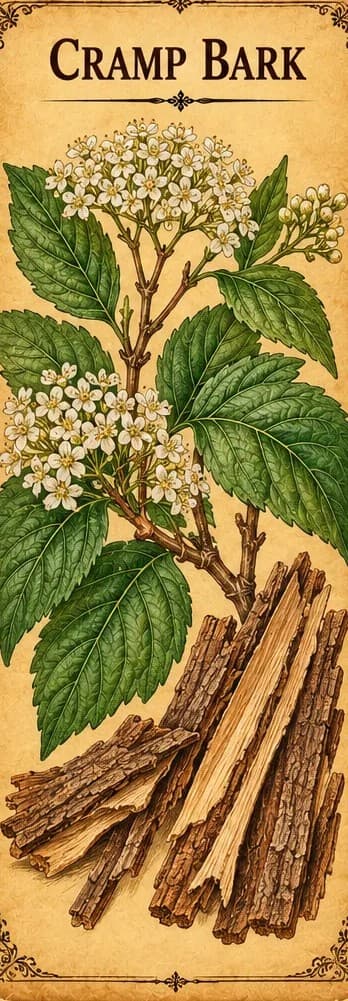
Cramp Bark
Viburnum opulus
The bark of the guelder rose, traditionally used for bleeding from the stomach or uterus and for haemorrhoids; the plant is used for coughs, colds and kidney problems. Research is in the lab and in animals.
What is Cramp Bark?
- Plant family
- Viburnaceae, the viburnum and elder family
- Parts used
- The bark; the red berries are also eaten and made into juice
- Genus
- Viburnum
- Species
- opulus
Also called
Crampbark, Guelder Rose, European Cranberrybush, Snowball Tree, Water Elder
Regional names
Gilaburu
Traditionally used for
- Stomach or uterine bleeding (traditional)
- Haemorrhoids (traditional)
- Coughs and colds (traditional)
- Kidney problems (traditional)
Traditionally described as
Health topics
Where Cramp Bark appears in symptom search, and why. Being listed doesn't mean it's a proven treatment.
- Cough
A traditional remedy for coughs and colds. Not tested in trials.
- Kidney Stones
A berry extract lowered stone-forming oxalate in rats. Not tested in people.
Traditions that use it
European Folk Medicine
Used for coughs, colds, rheumatic aches, ulcers, and stomach and kidney problems; the bark for stomach or uterine bleeding and haemorrhoids.
What does the research say?
Traditional use
These are traditional uses, not proven treatments.
Cramp bark, also called guelder rose, is traditionally used for coughs, colds, tuberculosis, rheumatic aches, ulcers, and stomach and kidney problems. The bark is used for bleeding from the stomach or uterus and for haemorrhoids.[1]
Its sour red berries are cooked into jams, cordials and pies in Russia and Ukraine. In Turkey, the fermented juice (gilaburu) is a traditional drink, also used for liver disease, diabetes and high blood pressure.[1]
Laboratory & animal research
Lab and animal results show what might be worth studying in people. They don't show that the herb has these effects in humans.
In rats, an extract of the berries increased urination and lowered oxalate, the main substance in kidney stones. A berry extract also relaxed blood vessels in lab tests. Lab studies of different parts of the plant report effects against microbes, inflammation, diabetes and cancer cells. These haven't been tested in people.[1]
Sources
- [1] Viburnum opulus L.—A Review of Phytochemistry and Biological Effects · DOI: 10.3390/nu12113398Peer-reviewed study
This information is educational and traditional in nature, and is not a substitute for professional medical advice.