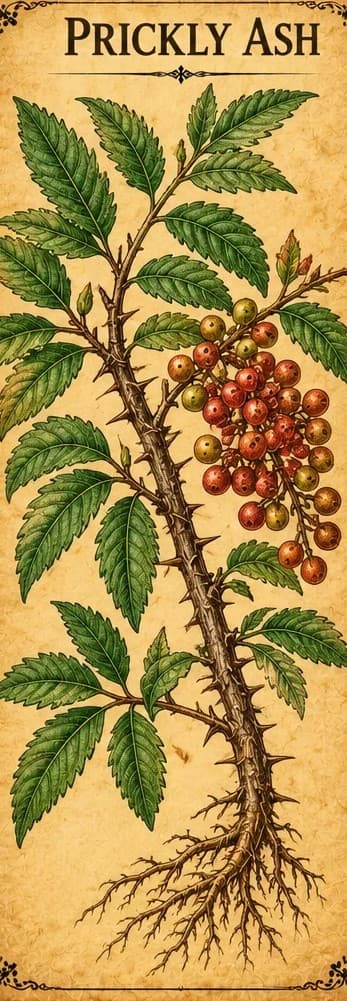
Prickly Ash
Zanthoxylum americanum
The "toothache tree", a thorny North American shrub whose bark Native Americans used for toothache, rheumatism, fevers, colds and coughs.
What is Prickly Ash?
- Plant family
- Rutaceae, the citrus family
- Parts used
- The bark, root bark and berries
- Where it grows
- North America, along riverbanks and in moist woods, thickets and rocky hillsides
- Genus
- Zanthoxylum
- Species
- americanum
Also called
Northern Prickly Ash, Common Pricklyash, Toothache Tree
Older scientific names
Xanthoxylum americanum
Traditionally used for
- Toothache (traditional)
- Rheumatism (traditional)
- Fever (traditional)
- Colds and coughs (traditional)
Traditionally described as
Health topics
Where Prickly Ash appears in symptom search, and why. Being listed doesn't mean it's a proven treatment.
- Colds and Nasal Congestion
Bark tea was a Native American remedy for colds, coughs and fever. Not tested in trials.
- Joint Discomfort
Native Americans used the bark for rheumatism and swollen joints. Not tested in trials.
Traditions that use it
Native American Ethnobotany
Used by many tribes, including the Cherokee, Creek, Iroquois, Ojibwa and Potawatomi, for toothache, rheumatism, fevers, colds and coughs.
Safety
Pregnancy
A strong decoction of the bark was taken by Native Americans to cause miscarriages.[1]
What does the research say?
Traditional use
These are traditional uses, not proven treatments.
Prickly ash is a thorny shrub or small tree whose twigs smell of lemon peel. Many Native American tribes used it as medicine. It's also called the toothache tree, because the bark was smoked, chewed or packed around an aching tooth.[1]
Native American uses recorded by the US Department of Agriculture include:
- Bark tea for back pain, cramps, lung problems, fevers, colds and coughs
- A wash of the bark for itchy skin and swollen joints
- Inner bark on the skin for rheumatism and sharp pains, or held in the throat for sore throats
- Root bark for colic, rheumatism and gonorrhea
- The berries for chest and throat illnesses, and in cough syrups
These are recorded uses, not tested treatments.[1]
In short
Native Americans used a bark decoction to cause miscarriage.
Sources
- [1] Plant Guide: Common Pricklyash, Zanthoxylum americanum P. Mill. — U.S. Department of Agriculture, Natural Resources Conservation Service, National Plant Data CenterGovernment health agency
This information is educational and traditional in nature, and is not a substitute for professional medical advice.