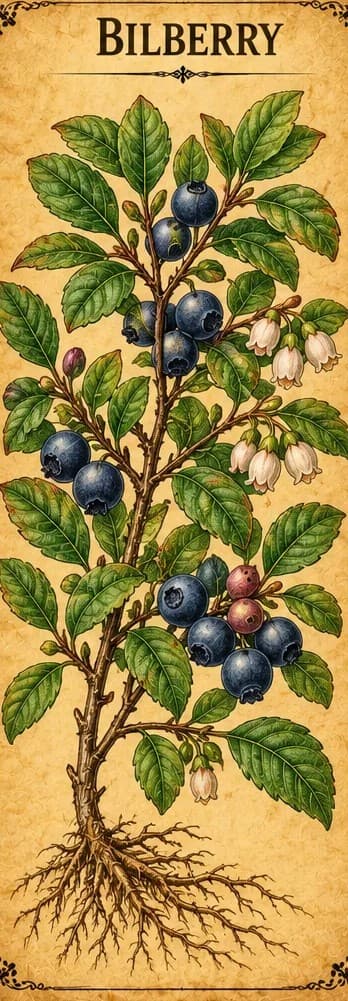
Bilberry
Vaccinium myrtillus
Dried bilberries are a traditional EU herbal medicine for mild diarrhea and mouth inflammation. Trials of supplements for blood sugar and heart health are small and inconclusive.
What is Bilberry?
- Plant family
- Ericaceae, the heather family
- Parts used
- The ripe berries, dried for medicine
- Genus
- Vaccinium
- Species
- myrtillus
Also called
European Blueberry, Whortleberry, Myrtilli fructus
Traditionally used for
- Mild diarrhea (traditional)
- Mouth inflammation (traditional)
- Blood sugar (studied)
Traditionally described as
- Antioxidant
Health topics
Where Bilberry appears in symptom search, and why. Being listed doesn't mean it's a proven treatment.
- Diarrhea
A traditional EU herbal medicine for mild diarrhea (as a tea of the dried berries). See a doctor if it lasts more than 3 days.
- High Blood Sugar
A review of small trials found a borderline drop in long-term blood sugar (HbA1c); evidence is weak.
Traditions that use it
European Folk Medicine
Dried bilberries are a traditional EU herbal medicine for mild diarrhea and for minor inflammation inside the mouth.
Safety
Side effects
No side effects or drug interactions are known for dried bilberries.[1]
Pregnancy
The European Medicines Agency says dried bilberries can be used during pregnancy and breastfeeding; no concerns about birth defects have arisen from eating them.[1]
What does the research say?
Traditional use
These are traditional uses, not proven treatments.
The European Medicines Agency recognises dried bilberries as a traditional herbal medicine, based on long use rather than trials, for:
- Mild diarrhea: a tea of 5 to 15 g of dried berries boiled in 250 ml of water, 3 to 4 times a day (15 to 60 g a day). See a doctor if it lasts more than 3 days.
- Minor inflammation inside the mouth: a mouth rinse of 20 g boiled in 200 ml of water, used several times a day. See a doctor if it lasts more than a week.
It isn't recommended for children under 12.[1]
Research in people
A 2025 review of 11 trials with 409 adults looked at bilberry supplements and heart and metabolic health. There was a borderline drop in long-term blood sugar (HbA1c), and triglycerides fell in short trials of 4 weeks or less. Bilberry didn't clearly change fasting blood sugar, cholesterol, blood pressure, weight or markers of inflammation. The authors say longer, high-quality trials are needed.[2]
Technical detail: HbA1c WMD −1.63% (95% CI −3.36 to 0.11; p = 0.06); fasting glucose WMD −0.08 mmol/L (−0.22 to 0.07).
In short
Not for children under 12 as a medicine. See a doctor if diarrhea lasts more than 3 days.
Sources
- [1] European Union herbal monograph on Vaccinium myrtillus L., fructus siccus (EMA/HMPC/678995/2013) — European Medicines Agency, Committee on Herbal Medicinal Products (HMPC)Government health agency
- [2] Investigating the Effects of Vaccinium myrtillus Supplementation on Cardiometabolic Indices: A Systematic Review and Meta-Analysis · DOI: 10.1002/ptr.70054Review or clinical trial
This information is educational and traditional in nature, and is not a substitute for professional medical advice.