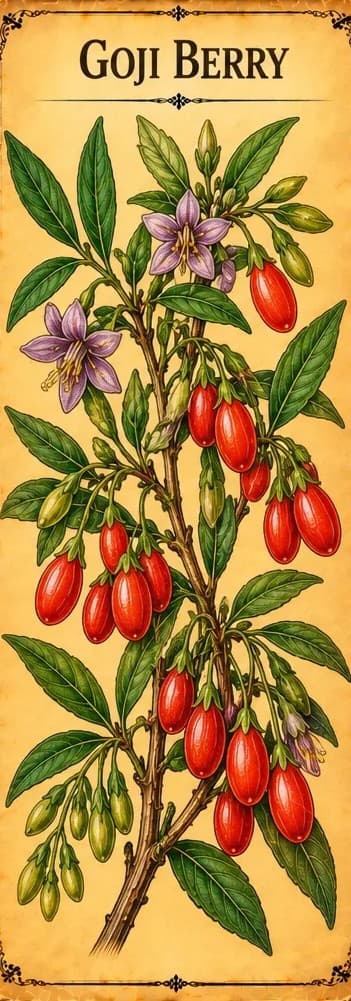
Goji Berry
Lycium barbarum
Small red berries known in China for over 2,000 years as a tonic, now a popular health food. Small trials suggest they may slightly lower triglycerides and raise "good" cholesterol.
Goji Berry may interact with some medicines. If you take any medicine, read Interactions with medicines below and talk to your doctor or pharmacist before using it.
What is Goji Berry?
- Plant family
- Solanaceae, the nightshade family
- Parts used
- The dried red berries, eaten, as juice or tea, or soaked in wine
- Where it grows
- China
- Genus
- Lycium
- Species
- barbarum
Also called
Goji, Wolfberry, Lycium
Traditional names
Gouqizi
Traditionally used for
- Tonic (traditional)
- Blood fats
- Health food
Traditionally described as
- Slightly lowered triglycerides (in small trials)
Health topics
Where Goji Berry appears in symptom search, and why. Being listed doesn't mean it's a proven treatment.
- High Cholesterol
Slightly lowered triglycerides and raised "good" HDL cholesterol in a review of 5 small trials; no effect on LDL.
Traditions that use it
Traditional Chinese Medicine
Known in China for over 2,000 years as a tonic for various organs.
Safety
Interactions with medicines
Goji can strengthen the blood thinner warfarin. A 65-year-old man on warfarin had blood in his urine after drinking 20 mL of goji wine, and a 61-year-old woman's blood-clotting test (INR) rose to 4.1 after drinking 3 to 4 glasses of strong goji tea a day for 4 days. Both returned to normal after stopping goji. In the lab, goji juice blocks the liver enzymes that break down warfarin.[1]
What does the research say?
Traditional use
These are traditional uses, not proven treatments.
Goji berries have been known in China for over 2,000 years, where the plant is used as a tonic for various organs. They're believed to help with diabetes, high blood fats, blood clots, a weak immune system, cancer, hepatitis and male infertility. Today they're added to health foods around the world.[1]
Research in people
A 2023 review combined 5 trials with 259 adults, mostly healthy people, who took goji berries, juice or extract for 4 to 16 weeks. Goji slightly lowered triglycerides (a type of blood fat) and slightly raised "good" HDL cholesterol. It didn't significantly change total or "bad" LDL cholesterol.[2]
Technical detail: triglycerides fell by 0.14 mmol/L (95% CI 0.08 to 0.20); HDL-C rose by 0.07 mmol/L (95% CI 0.01 to 0.13); changes in TC and LDL-C were not significant.
In short
Can strengthen the blood thinner warfarin and raise bleeding risk.
Sources
- [1] Hazardous Interactions Between Food, Herbs, and Drugs in the First Stage of Biotransformation: Case Reports of Adverse Drug Interactions in Humans · DOI: 10.3390/ijms26115188Peer-reviewed study
- [2] L. barbarum (Lycium barbarum L.) supplementation for lipid profiles in adults: A systematic review and meta-analysis of RCTs · DOI: 10.1097/MD.0000000000034952Review or clinical trial
This information is educational and traditional in nature, and is not a substitute for professional medical advice.