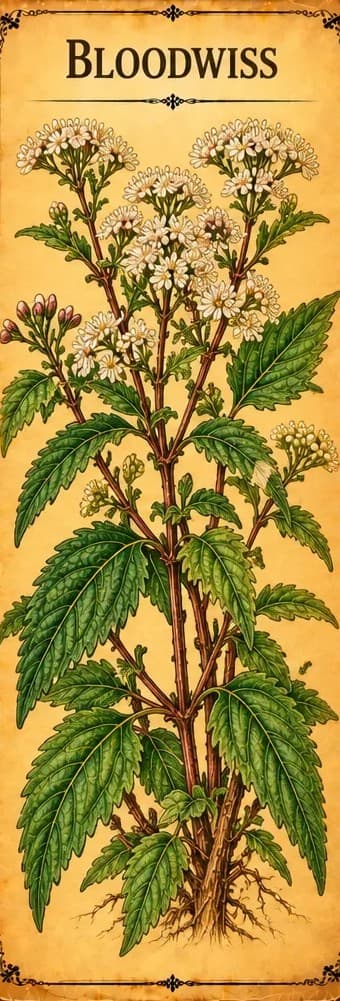
Bloodwiss
Vitis tiliifolia
A wild grapevine. Old Mexican records list it for increasing urination, fever and gout, and the vine has been used as a source of drinking water. Very little research exists.
What is Bloodwiss?
- Plant family
- Vitaceae, the grape family
- Parts used
- The leaves, usually as a tea; the vine is also a source of water
- Genus
- Vitis
- Species
- tiliifolia
Also called
Blood Wiss, Vitis tiliifolia
Traditionally used for
- Increasing urination (traditional)
- Fever (traditional)
- Gout (traditional)
- Drinking water from the vine
Traditionally described as
- Antioxidant (in lab studies)
What does the research say?
Traditional use
These are traditional uses, not proven treatments.
Bloodwiss is a wild grapevine. Folk-use records collected by the US Department of Agriculture, mostly from older Mexican surveys, list it for:
- Increasing urination
- Fever
- Gout
- Tumors
In Mexico and Honduras, the vine has also been used as a source of drinking water. These are recorded uses, not tested treatments.[1]
Laboratory & animal research
Lab and animal results show what might be worth studying in people. They don't show that the herb has these effects in humans.
A 2020 lab study of tea made from the leaves of wild Mexican vines found 14 plant compounds, including resveratrol, quercetin and rutin, and antioxidant activity. The amounts varied a lot between vines. This was a chemistry study and doesn't show any health effect.[2]
In short
Its safety hasn't been studied.
Sources
- [1] Dr. Duke's Phytochemical and Ethnobotanical Databases: Vitis tiliifolia — U.S. Department of Agriculture, Agricultural Research ServiceGeneral reference
- [2] Phenolic Content and Antioxidant Capacity of Infusions of Vitis tiliifolia (Humb & Bonpl. Ex Schult.) LeavesPeer-reviewed study
This information is educational and traditional in nature, and is not a substitute for professional medical advice.