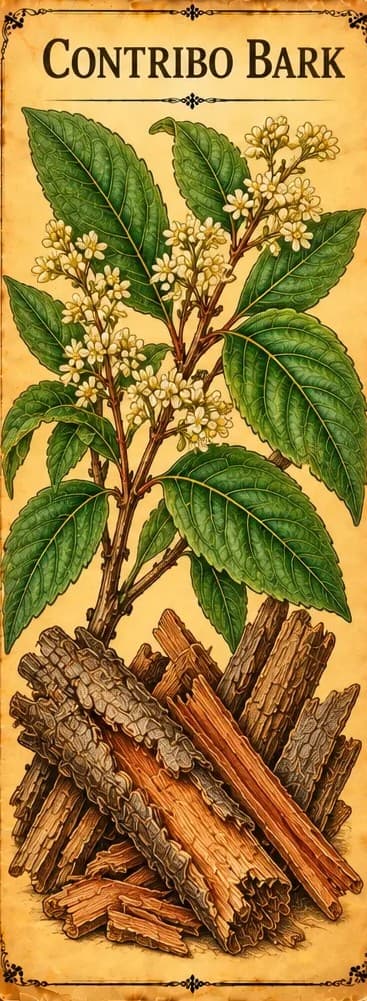
Contribo
Aristolochia trilobata
An Aristolochia vine used in Caribbean and Latin American folk medicine for stomach aches, colic and asthma. It contains aristolochic acids, which cause kidney failure and urinary tract cancer.
What is Contribo?
- Plant family
- Aristolochiaceae, the birthwort family
- Parts used
- The leaves and stems
- Where it grows
- The Caribbean, Central America and South America
- Genus
- Aristolochia
- Species
- trilobata
Also called
Contribo Bark, Birthwort, Aristolochia
Regional names
Mil-Homens
Traditionally used for
- Stomach aches and colic (traditional)
- Asthma (traditional)
- Protection from poisoning and hexes (traditional
- Martinique)
Traditionally described as
- Reduced pain and inflammation (in mice)
Health topics
Where Contribo appears in symptom search, and why. Being listed doesn't mean it's a proven treatment.
- Indigestion
Warning: traditionally used for stomach aches and colic, but contribo contains aristolochic acids, which cause kidney failure and cancer.
Traditions that use it
Caribbean Folk Medicine
Used in folk medicine across the Caribbean and Central and South America for stomach aches, colic, asthma and other complaints. It contains kidney-damaging, cancer-causing aristolochic acids.
Safety
Toxicity testing
Aristolochia plants such as contribo contain aristolochic acids, which cause kidney failure and cancer of the urinary tract. In the 1990s, many young women in Belgium developed kidney failure and urinary tract cancer after taking slimming pills containing an Aristolochia herb. Large studies in Taiwan later linked herbs containing aristolochic acid to kidney failure and cancer, and the reviewers call for such herbs to be banned.[1]
Aristolochic acids I and II were found in samples of chiniy-trèf, the Martinique preparation made with caterpillars that feed on contribo.[2]
Testing of chiniy-trèf showed a real risk of kidney damage and cancer for people who drink it. Martinique's health agency issued an alert about it in 2015.[3]
What does the research say?
Traditional use
These are traditional uses, not proven treatments.
In Central and South America, where it's known as mil-homens, contribo is an important folk medicine. It's used for:
- Stomach aches and colic
- Asthma and lung diseases
- Diabetes
- Skin problems
In Martinique, a folk preparation called chiniy-trèf is made by soaking the caterpillars that feed on contribo leaves, sometimes with a leaf of the plant, in rum. It's taken to protect against "any manifestation of evil", including poisoning and hexes.[3]
Laboratory & animal research
Lab and animal results show what might be worth studying in people. They don't show that the herb has these effects in humans.
In mice, the oil distilled from contribo and its main compound reduced pain and inflammation. This doesn't show that the plant is safe or effective for people.[4]
In short
Contains aristolochic acids, which cause kidney failure and cancer. Herbs containing them have been linked to kidney failure and cancer in many people.
Sources
- [1] Chinese herbs containing aristolochic acid associated with renal failure and urothelial carcinoma: a review from epidemiologic observations to causal inference · DOI: 10.1155/2014/569325Peer-reviewed study
- [2] Detection of aristolochic acids I and II in "Chiniy-trèf", a traditional medicinal preparation containing caterpillars feeding on Aristolochia trilobata L. in Martinique, French West Indies · DOI: 10.1016/j.toxicon.2016.02.013Peer-reviewed study
- [3] Health risk associated with the oral consumption of "Chiniy-tref", a traditional medicinal preparation used in Martinique (French West Indies): Qualitative and quantitative analyses of aristolochic acids contained therein · DOI: 10.1016/j.toxicon.2019.10.241Peer-reviewed study
- [4] Aristolochia trilobata: Identification of the Anti-Inflammatory and Antinociceptive Effects · DOI: 10.3390/biomedicines8050111Peer-reviewed study
This information is educational and traditional in nature, and is not a substitute for professional medical advice.