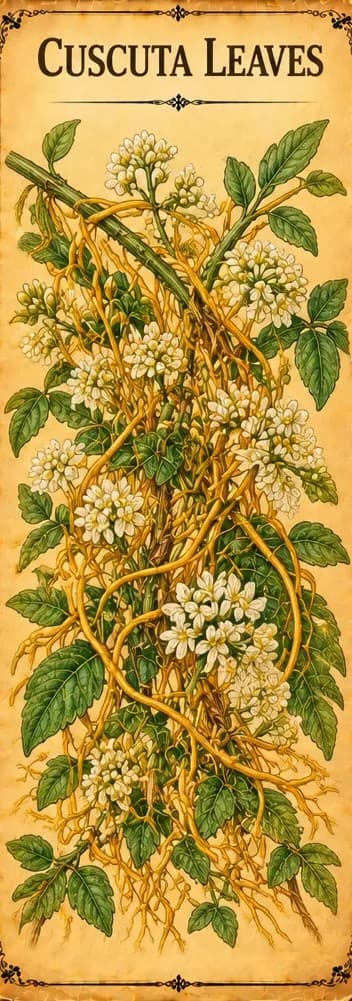
Cuscuta
Cuscuta chinensis
Dodder, a leafless-looking parasitic vine. Its seed, tu si zi, is a top-grade Chinese tonic for the liver and kidneys, eyesight, fertility and keeping pregnancies stable.
Cuscuta may interact with some medicines. If you take any medicine, read Interactions with medicines below and talk to your doctor or pharmacist before using it.
What is Cuscuta?
- Plant family
- Convolvulaceae, the morning glory family
- Parts used
- The seeds (tu si zi)
- Genus
- Cuscuta
- Species
- chinensis
Also called
Dodder, Chinese Dodder, Cuscuta Leaves, Cuscutae Semen, Love Vine
Traditional names
Tu Si Zi, Tusizi
Traditionally used for
- Fertility (traditional)
- Liver and kidney tonic (traditional)
- Eyesight (traditional)
- Anti-ageing (traditional)
- Aphrodisiac (traditional)
Traditionally described as
- Affected sex hormones (in animal studies)
- Antioxidant (in lab studies)
Health topics
Where Cuscuta appears in symptom search, and why. Being listed doesn't mean it's a proven treatment.
- Fertility
Traditionally used for infertility; formulas containing it improved sperm quality in trials of uncertain quality. Not tested on its own.
- Sexual Health
Used as an aphrodisiac in several Asian traditions. Not tested in trials.
Traditions that use it
Traditional Chinese Medicine
The seed, tu si zi, is a top-grade tonic in the Shennong Herbal Classic, used for the liver and kidneys, eyesight, keeping pregnancies stable and fertility.
Safety
Interactions with medicines
Based mostly on lab and animal research, dodder seed may interact with:
- Hormone treatments, including birth control pills and hormone replacement therapy
- Diabetes medicines, raising the risk of low blood sugar
- Medicines that suppress the immune system, possibly weakening them
- Other medicines, by changing how the liver breaks them down
Pregnancy
Although it's traditionally used to keep pregnancies stable, a 2014 review lists effects that could cause abortion among those seen in research on Chinese dodder.[2]
Toxicity testing
In mice, dodder seed extract had low toxicity. At high doses it reduced body weight, changed blood counts and raised liver enzymes. There's little information on side effects in people. The Chinese Pharmacopoeia recommends 6 to 12 g of the dried seed a day.[1]
What does the research say?
Traditional use
These are traditional uses, not proven treatments.
Chinese dodder is used as a traditional medicine in China, Korea, Pakistan, Vietnam, India and Thailand, most often against ageing, for inflammation and pain, and as an aphrodisiac.[2]
Dodder is a group of about 170 parasitic plants. They have tiny scale-like leaves and little or no green colouring, and live by wrapping around a host plant and drawing food from it. People in many parts of the world use dodders in foods and traditional medicine.[3]
The seed of Chinese dodder, tu si zi, was ranked a top-grade herb in the Shennong Herbal Classic. It's a tonic used to:
- Nourish the liver and kidneys
- Improve eyesight
- Keep a pregnancy stable ("calm the fetus")
- Improve sperm quality and treat infertility
- Reduce frequent urination
Laboratory & animal research
Lab and animal results show what might be worth studying in people. They don't show that the herb has these effects in humans.
In lab and animal studies, the seed and its compounds (especially flavonoids) affected sex hormones and improved signs of male and female infertility, early menopause (premature ovarian insufficiency) and polycystic ovary syndrome. Other research suggests possible benefits for bone loss, kidney disease linked to diabetes, Alzheimer's disease and ageing. These haven't been confirmed in people.[1]
Research in people
There are no clinical trials of dodder seed on its own, only of Chinese formulas that contain it. A review of 16 studies with 1,960 men found that one such formula, Wuzi Yanzong pill, improved sperm count and movement and pregnancy rates more than Western medicine. The quality of these trials may be poor, and more high-quality trials are needed.[1]
In short
May interact with hormone, diabetes and immune-suppressing medicines. Research lists possible effects that could cause abortion.
Sources
- [1] Therapeutic roles and molecular mechanisms of Cuscutae Semen in reproductive diseases · DOI: 10.3389/fimmu.2025.1659342Peer-reviewed study
- [2] Cuscuta chinensis Lam.: A systematic review on ethnopharmacology, phytochemistry and pharmacology of an important traditional herbal medicine · DOI: 10.1016/j.jep.2014.09.032Peer-reviewed study
- [3] The genus Cuscuta (Convolvolaceac): An updated review on indigenous uses, phytochemistry, and pharmacology · DOI: 10.22038/ijbms.2019.35296.8407Peer-reviewed study
This information is educational and traditional in nature, and is not a substitute for professional medical advice.