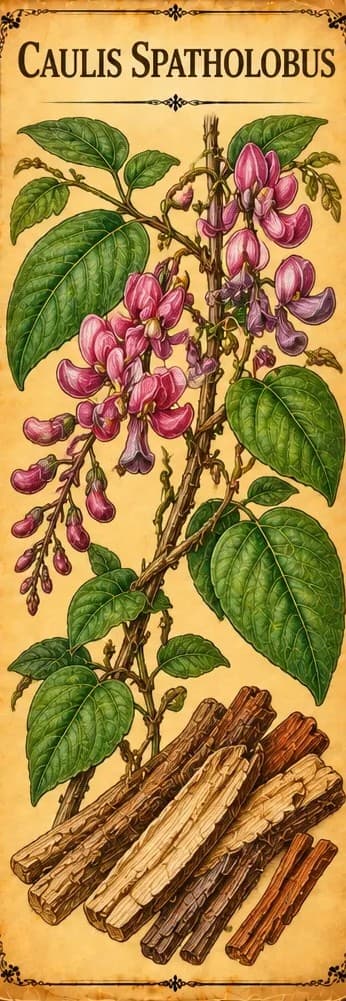
Caulis Spatholobus
Spatholobus suberectus
Ji xue teng, or "chicken blood vine", a woody vine whose cut stem oozes red sap. It's used in Chinese medicine for anemia, irregular periods and rheumatic joint pain.
What is Caulis Spatholobus?
- Plant family
- Fabaceae, the pea and bean family
- Parts used
- The dried, woody vine stem
- Where it grows
- China and parts of Southeast Asia
- Genus
- Spatholobus
- Species
- suberectus
Also called
Spatholobi Caulis, Chicken Blood Vine, Spatholobus
Traditional names
Ji Xue Teng, Jixueteng
Traditionally used for
- Anemia (traditional)
- Irregular periods (traditional)
- Rheumatic joint pain (traditional)
- Numbness (traditional)
Traditionally described as
- Helped make blood cells (in lab and animal studies)
- Antioxidant (in lab studies)
Health topics
Where Caulis Spatholobus appears in symptom search, and why. Being listed doesn't mean it's a proven treatment.
- Joint Discomfort
Traditionally used in Chinese medicine for rheumatic joint pain. Not tested on its own in trials.
- Menstrual Discomfort
Traditionally used to regulate menstruation and for other women's health problems. Not tested on its own in trials.
Traditions that use it
Traditional Chinese Medicine
Called ji xue teng ("chicken blood vine"); used for nearly 1,000 years for anemia, irregular menstruation and rheumatic joint pain.
Safety
Toxicity testing
Research on its toxicity is limited.[1]
What does the research say?
Traditional use
These are traditional uses, not proven treatments.
In Chinese it's called ji xue teng, meaning "chicken blood vine", because a blood-red sap flows from the stem when it's cut. It has been used in Chinese medicine for nearly 1,000 years for anemia, rheumatism and irregular periods.[2]
Chinese medicine uses the vine stem to "promote blood circulation and nourish the blood", regulate menstruation and relieve pain. It's traditionally used for:
- Rheumatic joint pain
- Numbness and paralysis
- "Blood deficiency"
- Irregular periods and other women's health problems
Laboratory & animal research
Lab and animal results show what might be worth studying in people. They don't show that the herb has these effects in humans.
In lab and animal studies, extracts and compounds from the stem have acted as antioxidants, lowered blood sugar, may help reduce inflammation, helped the body make blood cells, protected nerves and killed microbes. Several compounds killed or slowed cancer cells, especially breast cancer cells. These haven't been confirmed in people.[2]
Research in people
Clinical reports from China describe its use for low white blood cell counts, aplastic anemia (when the bone marrow stops making enough blood cells) and endometriosis, usually as part of herbal formulas. The review summarizing them didn't rate how strong this evidence is.[1]
In short
Research on its toxicity is limited.
Sources
- [1] Spatholobi caulis: A systematic review of its traditional uses, chemical constituents, biological activities and clinical applications · DOI: 10.1016/j.jep.2023.116854Peer-reviewed study
- [2] A Review of the Pharmacological Potential of Spatholobus suberectus Dunn on Cancer · DOI: 10.3390/cells11182885Peer-reviewed study
- [3] A comprehensive review: Botany, phytochemistry, traditional uses, pharmacology, and toxicology of Spatholobus suberectus vine stems · DOI: 10.1016/j.jep.2023.116500Peer-reviewed study
This information is educational and traditional in nature, and is not a substitute for professional medical advice.