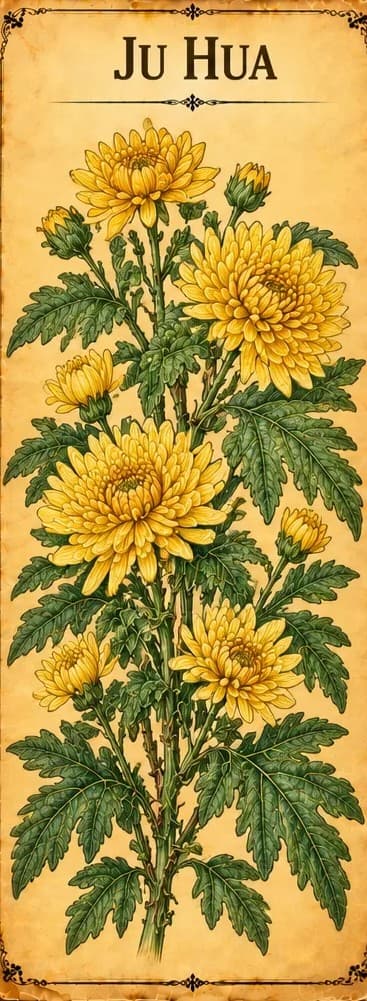
Ju Hua
Chrysanthemum morifolium
Chrysanthemum flowers, drunk as tea in China for over 3,000 years and used in Chinese medicine for colds, dizziness, headaches and the eyes. It hasn't been tested on its own in clinical trials.
What is Ju Hua?
- Plant family
- Asteraceae, the daisy family
- Parts used
- The dried flower heads, usually as tea; also in decoctions and patent medicines, or as a wash or paste on the skin
- Where it grows
- China
- Genus
- Chrysanthemum
- Species
- morifolium
Also called
Chrysanthemum, Chrysanthemum Flower, Chrysanthemum Tea, Chrysanthemi Flos
Traditional names
Juhua
Traditionally used for
- Colds (traditional)
- Dizziness and headache (traditional)
- Eyes (traditional)
- Tea
Traditionally described as
- Kills microbes (in lab studies)
- Antioxidant (in lab studies)
Health topics
Where Ju Hua appears in symptom search, and why. Being listed doesn't mean it's a proven treatment.
- Colds and Nasal Congestion
Used in Chinese medicine and patent medicines for colds ("wind-heat"). Not tested on its own in trials.
- Headache
Traditionally used for dizziness and pain caused by "wind". Not tested on its own in trials.
Traditions that use it
Traditional Chinese Medicine
Called ju hua; recorded since the Shennong Herbal Classic. Used to "disperse wind-heat", calm the liver, brighten the eyes, and for dizziness and colds.
Safety
Toxicity testing
In rat studies, a single large dose of ju hua extract and daily doses for 26 weeks caused no signs of harm. These were animal tests, not studies in people. The Chinese Pharmacopoeia lists a dose of 5 to 10 g.[1]
What does the research say?
Traditional use
These are traditional uses, not proven treatments.
Ju hua comes from China, where it has been used for more than 3,000 years, first as a food and tea and later as a medicine. It's still drunk as a flower tea for health and is used for colds and inflammation.[2]
The Shennong Herbal Classic, the earliest record, used it mainly for dizziness and pain caused by "wind". Later texts say it benefits the liver, and a Qing Dynasty doctor wrote that drinking it for a long time strengthens the body and promotes long life. Today the Chinese Pharmacopoeia lists it to:
- "Disperse wind and clear heat", as in colds
- Calm the liver and "brighten the eyes"
- "Clear toxins"
It's an ingredient in Chinese patent medicines for colds and coughs, pain and eyesight.[1]
Laboratory & animal research
Lab and animal results show what might be worth studying in people. They don't show that the herb has these effects in humans.
In lab and animal studies, ju hua extracts and compounds have killed or slowed bacteria and viruses, may help reduce inflammation, acted as antioxidants and affected the immune system. These haven't been confirmed in people.[1]
Research in people
A 2025 review found no clinical studies of ju hua on its own. In Chinese medicine it's usually given as part of a formula with other herbs, which makes single-herb trials hard to do.[1]
Sources
- [1] Exploring the antimicrobial, anti-inflammatory, antioxidant, and immunomodulatory properties of Chrysanthemum morifolium and Chrysanthemum indicum: a narrow review · DOI: 10.3389/fphar.2025.1538311Peer-reviewed study
- [2] Chrysanthemum morifolium as a traditional herb: A review of historical development, classification, phytochemistry, pharmacology and application · DOI: 10.1016/j.jep.2024.118198Peer-reviewed study
This information is educational and traditional in nature, and is not a substitute for professional medical advice.