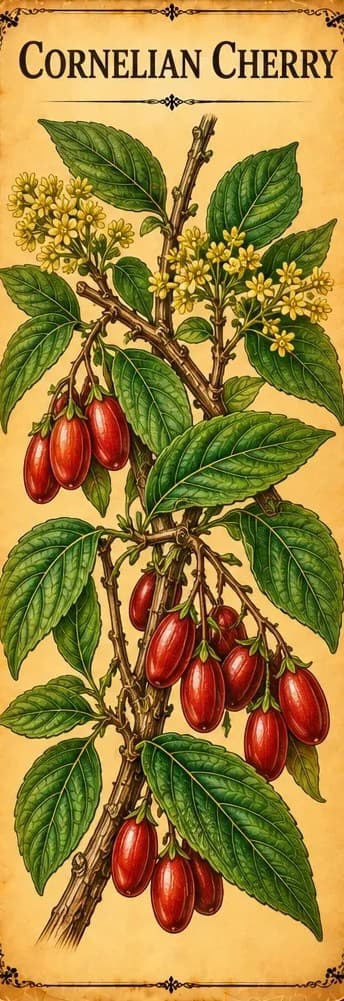
Cornelian Cherry
Cornus officinalis
Shan zhu yu, the sour fruit of an Asian dogwood, used in Chinese medicine for about 2,000 years as a liver and kidney tonic and for dizziness, ringing in the ears, frequent urination and heavy sweating. Research so far is in the lab and in animals.
What is Cornelian Cherry?
- Plant family
- Cornaceae, the dogwood family
- Parts used
- The ripe, dried fruit ("Cornus flesh")
- Where it grows
- Eastern Asia, mainly China, as well as Korea and Japan
- Genus
- Cornus
- Species
- officinalis
Also called
Corni Fructus, Asiatic Dogwood, Japanese Cornel, Cornel Dogwood
Traditional names
Shan Zhu Yu, Shanzhuyu
Traditionally used for
- Liver and kidney tonic (traditional)
- Dizziness and ringing in the ears (traditional)
- Frequent urination (traditional)
- Heavy sweating (traditional)
- Heavy menstrual bleeding (traditional)
Traditionally described as
- Lowered blood sugar (in animal studies)
- Protected nerve cells (in lab and animal studies)
Health topics
Where Cornelian Cherry appears in symptom search, and why. Being listed doesn't mean it's a proven treatment.
- Hair Loss
A traditional use in Chinese medicine. Not studied in modern research.
- High Blood Sugar
Traditionally used for thirst with frequent urination (signs of diabetes), and lowered blood sugar in animal studies. Not tested in clinical trials.
Traditions that use it
Traditional Chinese Medicine
Called shan zhu yu; recorded since the Shennong Ben Cao Jing and used for about 2,000 years as a liver and kidney tonic, and for dizziness, ringing in the ears, frequent urination and heavy sweating.
What does the research say?
Traditional use
These are traditional uses, not proven treatments.
Shan zhu yu has been used in Chinese medicine for nearly 2,000 years and is first recorded in the Shennong Ben Cao Jing. It's described as sour, astringent and warming, and is used for:
- Dizziness and ringing in the ears
- Weakness in the lower back and knees
- Impotence and involuntary loss of semen
- Heavy sweating
It has also been used for infections, inflammation, and nerve and urinary or reproductive disorders.[1]
In Chinese medicine it's a tonic for the liver and kidneys, used for weakness, liver and kidney diseases and reproductive problems. The classic Compendium of Materia Medica says it stops heavy menstrual bleeding and treats frequent urination in older people. It has also long been used for thirst with frequent urination, now recognized as signs of diabetes, and for ringing in the ears, deafness, forgetfulness and hair loss.[2]
This Asian cornelian cherry grows mainly in China, Korea and Japan. It's a close relative of the European cornelian cherry (Cornus mas), but the two plants' medicinal uses grew up separately.[3]
Besides its use as medicine, the fruit is used in foods such as drinks, jams, preserves and canned products.[4]
Laboratory & animal research
Lab and animal results show what might be worth studying in people. They don't show that the herb has these effects in humans.
In lab and animal studies, the fruit and its compounds (especially morroniside and loganin) have lowered blood sugar, protected nerve cells, the liver and the kidneys, slowed bone loss, affected the immune system, protected the heart, and acted as antioxidants and may help reduce inflammation. Researchers say clinical trials are still needed to find out whether these effects happen in people.[2]
Research in people
A 2025 review found that research on shan zhu yu is mainly lab and animal studies, and that clinical trials are lacking, so there's no good evidence yet on whether it works or is safe in people.[1]
In short
Hasn't been tested in clinical trials, so its safety in people isn't established.
Sources
- [1] Cornus officinalis Sieb.: An updated review on the ethnopharmacology, phytochemistry, pharmacology, toxicology, and pharmacokinetics · DOI: 10.1016/j.jep.2025.120365Peer-reviewed study
- [2] Active Components and Pharmacological Effects of Cornus officinalis: Literature Review · DOI: 10.3389/fphar.2021.633447Peer-reviewed study
- [3] Cornus mas and Cornus Officinalis—Analogies and Differences of Two Medicinal Plants Traditionally Used · DOI: 10.3389/fphar.2018.00894Peer-reviewed study
- [4] A comprehensive review of Cornus officinalis: health benefits, phytochemistry, and pharmacological effects for functional drug and food development · DOI: 10.3389/fnut.2023.1309963Peer-reviewed study
This information is educational and traditional in nature, and is not a substitute for professional medical advice.