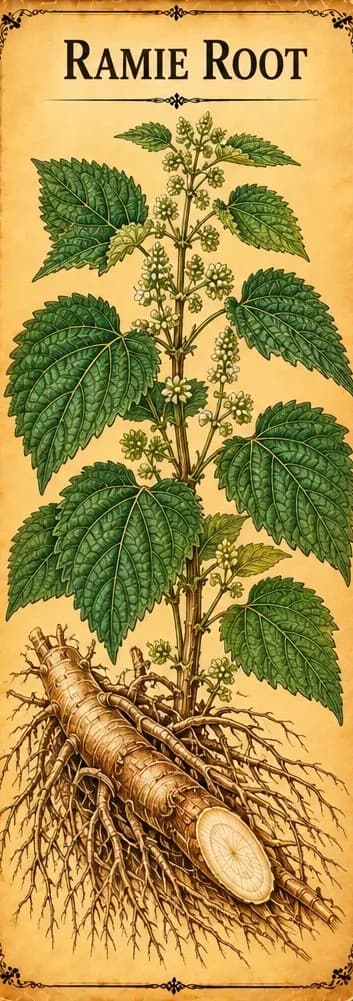
Ramie Root
Boehmeria nivea
Zhu ma gen, the root of a nettle-family plant used in Chinese medicine for threatened miscarriage, colic in pregnancy and skin infections. It hasn't been tested on its own in people.
What is Ramie Root?
- Plant family
- Urticaceae, the nettle family
- Parts used
- The root; the leaves are also used
- Where it grows
- Eastern Asia
- Genus
- Boehmeria
- Species
- nivea
Also called
Ramie, Chinese Grass
Traditional names
Zhu Ma Gen
Traditionally used for
- Threatened miscarriage (traditional)
- Stopping bleeding (traditional)
- Impetigo (traditional)
- Vaginal discharge (traditional)
Traditionally described as
- Calmed allergic reactions (in lab and mouse studies)
Health topics
Where Ramie Root appears in symptom search, and why. Being listed doesn't mean it's a proven treatment.
- Pregnancy and Childbirth
The root is traditionally used in Chinese medicine for threatened miscarriage. Its safety and effect in pregnancy haven't been shown in people.
Traditions that use it
Traditional Chinese Medicine
Called zhu ma gen; the root is used for threatened miscarriage, colic in pregnancy, impetigo and vaginal discharge.
Safety
Toxicity testing
In animal tests, ramie leaf extract caused no harm to rats given it daily for 28 days, and a single large dose of ramie didn't harm pregnant mice or their unborn young. These were animal tests, not studies in people.[1]
What does the research say?
Traditional use
These are traditional uses, not proven treatments.
Ramie is a plant of the nettle family from eastern Asia, used in traditional Chinese medicine. Its leaves are used for wounds, and its roots for:
- Threatened miscarriage
- Colic during pregnancy
- Impetigo, a skin infection
- Vaginal discharge
In folk medicine, the roots, leaves and flowers of ramie have been used to stop bleeding, protect the liver and increase urination. Traditional Korean medicine also uses it to reduce fever, and it's regarded as a medicinal food.[1]
Ramie root (zhu ma gen) is one of the ingredients of Yunkang oral liquid, a Chinese medicine used alongside standard care for threatened miscarriage in early pregnancy. In pregnant mice, the formula reduced the loss of embryos. A review of its trials in people was planned in 2022.[3]
Laboratory & animal research
Lab and animal results show what might be worth studying in people. They don't show that the herb has these effects in humans.
In short
Its safety in pregnancy hasn't been shown in people.
Sources
- [1] Boehmeria nivea (L.) Gaud. ameliorate oxidative stress-mediated inflammatory Responses and apoptosis in LPS/CSC-induced chronic obstructive pulmonary disease mouse model · DOI: 10.3389/fphar.2025.1710694Peer-reviewed study
- [2] Extract of Boehmeria nivea Suppresses Mast Cell-Mediated Allergic Inflammation by Inhibiting Mitogen-Activated Protein Kinase and Nuclear Factor-κB · DOI: 10.3390/molecules25184178Peer-reviewed study
- [3] Efficacy and safety of Yunkang oral liquid combined with conventional therapy for threatened miscarriage of first-trimester pregnancy: a protocol for systematic review and meta-analysis · DOI: 10.1371/journal.pone.0263581Peer-reviewed study
This information is educational and traditional in nature, and is not a substitute for professional medical advice.