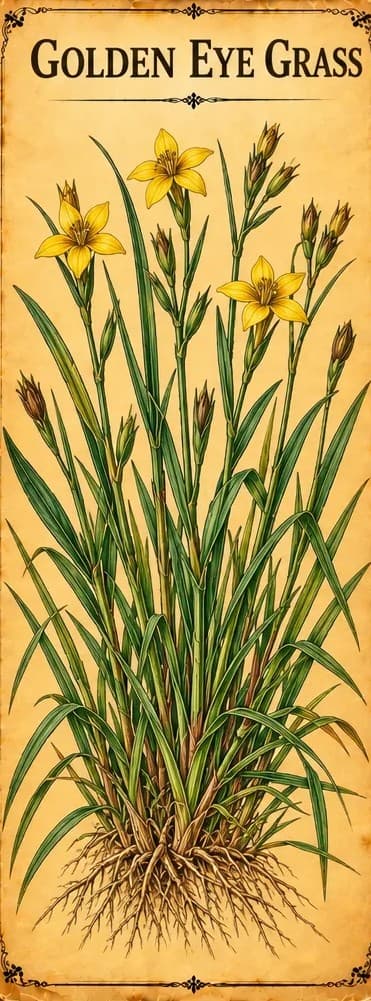
Golden Eye Grass
Curculigo orchioides
Kali musli or xian mao, an endangered herb valued in Ayurveda and Chinese medicine as a tonic and aphrodisiac, and used for rheumatic conditions. Research so far is in the lab and in animals.
What is Golden Eye Grass?
- Plant family
- Hypoxidaceae, the star-grass family
- Parts used
- The underground stem (rhizome) and root, used raw or processed with yellow rice wine
- Where it grows
- India
- Genus
- Curculigo
- Species
- orchioides
Also called
Black Musli, Curculigo
Regional names
Talmuli
Traditional names
Kali Musli, Xian Mao
Traditionally used for
- Tonic (traditional)
- Aphrodisiac (traditional)
- Rheumatic conditions (traditional)
- Jaundice and asthma (traditional)
- Urinary infections (traditional)
Traditionally described as
- Lowered blood sugar (in mice)
- Antioxidant (in lab studies)
Health topics
Where Golden Eye Grass appears in symptom search, and why. Being listed doesn't mean it's a proven treatment.
- High Blood Sugar
A root extract lowered blood sugar in diabetic mice. Not tested in people.
- Joint Discomfort
Used in Chinese medicine for rheumatic conditions, and reduced arthritis in mice. Not tested in people.
- Sexual Health
Valued as an aphrodisiac in Ayurveda and Chinese medicine. Not tested in trials.
Traditions that use it
Ayurveda
Called kali musli; a rasayana (rejuvenating) herb valued as a tonic and aphrodisiac.
Traditional Chinese Medicine
Called xian mao; the rhizome is used as a tonic for vitality, the liver and kidneys, and for rheumatic conditions.
Safety
Toxicity testing
In a mouse study, the raw root showed more potential to harm the kidneys than the root processed with rice wine.[1]
What does the research say?
Traditional use
These are traditional uses, not proven treatments.
In India, golden eye grass is known as kali musli. In Ayurveda it's a rasayana, or rejuvenating herb, valued as a tonic that helps the body cope with stress and as an aphrodisiac. It's an ingredient in many Ayurvedic preparations and is also used in Chinese and Japanese (Kampo) herbal medicine. The plant is endangered.[2]
In traditional Chinese medicine the rhizome is used as a tonic to keep up vitality and to nourish the liver and kidneys. In Ayurveda it's used for:
- Jaundice and asthma
- Urinary, bladder and kidney infections
- Skin illnesses
- Piles, diarrhea and colic
- Gonorrhea and sexual problems
Both traditions value it as an aphrodisiac.[3]
Chinese medicine has used it for centuries for rheumatic conditions and to "tonify kidney yang", a Chinese medicine idea about strengthening the body's warming energy. It's traditionally processed with yellow rice wine, which is believed to make it work better and lower its toxicity.[1]
Laboratory & animal research
Lab and animal results show what might be worth studying in people. They don't show that the herb has these effects in humans.
In a 2025 study, a root extract showed antioxidant activity in the lab and lowered blood sugar by about half in diabetic mice. This hasn't been tested in people.[3]
Technical detail: blood glucose fell 47.28% at 100 mg/kg and 52.11% at 200 mg/kg in alloxan-induced diabetic mice.
In a 2026 study in mice with arthritis, both the raw and the wine-processed root reduced paw swelling and joint inflammation. This hasn't been tested in people.[1]
In short
In mice, the raw root showed more potential to harm the kidneys than the wine-processed root.
Sources
- [1] Spectrum-effect relationship and network pharmacology reveal key anti-rheumatoid arthritis and attenuated toxicity components of processed curculigo rhizome · DOI: 10.1016/j.jep.2026.122244Peer-reviewed study
- [2] Curculigo orchioides: the black gold with numerous health benefits · DOI: 10.3736/jcim20100703Peer-reviewed study
- [3] GCMS profiling of bioactive phytocompounds from Curculigo orchiodes Gaertn. root extract and evaluation of antioxidant, and antidiabetic activities: A computational drug development approach · DOI: 10.1371/journal.pone.0335403Peer-reviewed study
This information is educational and traditional in nature, and is not a substitute for professional medical advice.