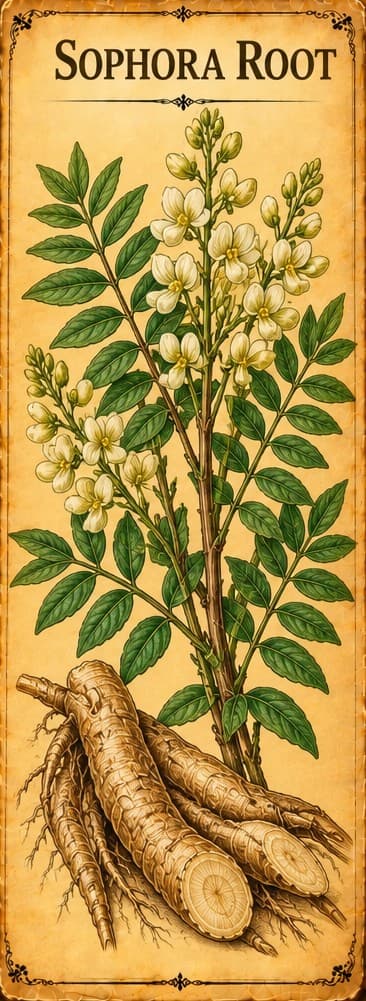
Sophora Root
Sophora flavescens
Ku shen, a bitter root used in Chinese medicine for over 1,700 years for dysentery, jaundice and skin diseases. Low-quality trials of a Chinese capsule containing it suggest it may help ulcerative colitis.
What is Sophora Root?
- Plant family
- Fabaceae, the pea and bean family
- Parts used
- The root
- Genus
- Sophora
- Species
- flavescens
Also called
Shrubby Sophora, Sephora Flavescens, Sephora Flavascens
Traditional names
Ku Shen
Traditionally used for
- Dysentery (traditional)
- Jaundice (traditional)
- Skin diseases (traditional)
- Ulcerative colitis
Traditionally described as
- Kills microbes (in lab studies)
- Antioxidant (in lab studies)
Traditions that use it
Traditional Chinese Medicine
Called ku shen; recorded in the Shennong Bencao Jing and used for over 1,700 years for dysentery, jaundice and skin diseases.
Safety
Toxicity testing
How sophora root's main compounds are processed by the body, and how toxic they are, hasn't been studied systematically.[1]
What does the research say?
Traditional use
These are traditional uses, not proven treatments.
Sophora root has been used in traditional Chinese medicine for over 1,700 years and was recorded in the Shennong Bencao Jing. It's used to "clear heat" and "dry dampness", to kill worms and to increase urination, and for dysentery, jaundice and skin diseases.[2]
Laboratory & animal research
Lab and animal results show what might be worth studying in people. They don't show that the herb has these effects in humans.
In lab and animal studies, flavonoids from sophora root have killed microbes and cancer cells, shown antioxidant activity, protected the liver, and lowered blood sugar. Some of its compounds killed several types of cancer cells while sparing normal cells.[2]
Research in people
A 2022 review combined 15 trials with 1,194 people with ulcerative colitis, a long-term inflammation of the bowel. A licensed Chinese capsule containing sophora root improved symptoms and bowel examinations slightly more often than standard medicines such as mesalazine, with no more side effects. The trials were few and of low quality, so the results should be treated with caution.[3]
Technical detail: clinical effective rate RR 1.12 (95% CI 1.05–1.20; 8 trials, 729 participants; low-quality evidence).
In short
Its safety hasn't been studied in detail.
Sources
- [1] Prenylated Flavonoids in Sophora flavescens: A Systematic Review of Their Phytochemistry and Pharmacology · DOI: 10.1142/S0192415X24500447Peer-reviewed study
- [2] Chemical composition, antitumor properties and underlying mechanism of Sophora flavescens flavonoids: A review · DOI: 10.1016/j.chmed.2026.02.011Peer-reviewed study
- [3] Five-Flavor Sophora flavescens Enteric-Coated Capsules for Ulcerative Colitis: A Systematic Review and Meta-Analysis of Randomized Clinical Trials · DOI: 10.1155/2022/9633048Review or clinical trial
This information is educational and traditional in nature, and is not a substitute for professional medical advice.