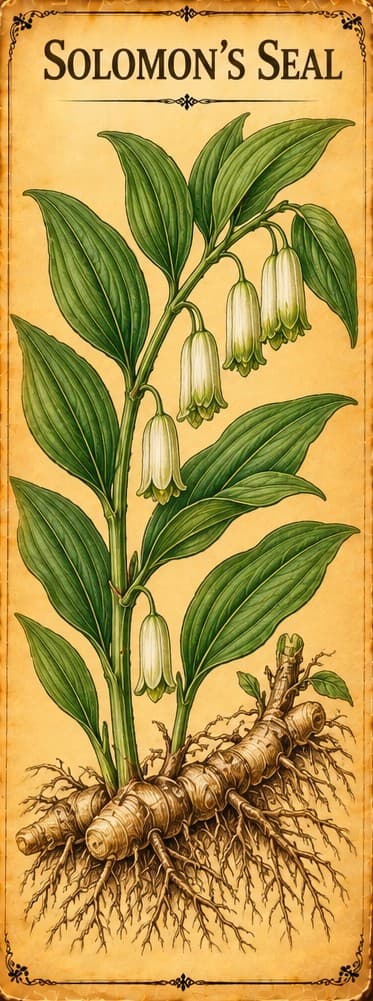
Solomon's Seal
Polygonatum odoratum
Angular Solomon's seal, or yu zhu, a root eaten as both food and medicine in China for over 2,000 years, used for dry coughs, thirst and a dry throat. Most research is in the lab and in animals.
What is Solomon's Seal?
- Plant family
- Asparagaceae, the asparagus family
- Parts used
- The underground stem (rhizome), sliced, as medicine and food
- Genus
- Polygonatum
- Species
- odoratum
Also called
Solomons Seal, Angular Solomon's Seal
Traditional names
Yu Zhu, Wei Rui
Traditionally used for
- Dry cough (traditional)
- Thirst (traditional)
- Dry throat (traditional)
- Food
Traditionally described as
- May lower blood sugar (in animal studies)
- Antioxidant (in lab studies)
Health topics
Where Solomon's Seal appears in symptom search, and why. Being listed doesn't mean it's a proven treatment.
- Cough
Used in traditional Chinese medicine for dry cough with little phlegm. Not tested in trials.
Traditions that use it
Traditional Chinese Medicine
Called yu zhu; listed as a superior-grade herb in the Shen Nong Ben Cao Jing and used as both food and medicine.
Safety
Toxicity testing
Plants in the Solomon's seal group are reported to have low toxicity, but their safety in people hasn't been studied in detail.[1]
What does the research say?
Traditional use
These are traditional uses, not proven treatments.
Solomon's seal was first recorded in China's Shen Nong Ben Cao Jing, where it was ranked a superior-grade herb, and it's eaten as both food and medicine. In traditional Chinese medicine it's used:
- For dry cough with little phlegm, and a dry throat and tongue
- For excessive thirst ("wasting thirst")
- For poor appetite and stomach discomfort after a high fever
Its name comes from scars on the root that look like old royal seals.[2]
Plants in the Solomon's seal group have been used for over 2,000 years as tonics in China, Japan, Korea, India, Iran and the Himalayas, mainly against ageing and tiredness and for metabolic problems.[1]
Laboratory & animal research
Lab and animal results show what might be worth studying in people. They don't show that the herb has these effects in humans.
In lab and animal studies, extracts and compounds from Solomon's seal have lowered blood sugar and shown effects on the immune system, as well as antioxidant, antiviral and antibacterial activity, and may help reduce inflammation.[2]
In short
Not well tested in people.
Sources
- [1] Botany, traditional uses, phytochemistry, pharmacology, toxicology, and applications of the genus Polygonatum: A comprehensive update review · DOI: 10.1016/j.jep.2026.121773Peer-reviewed study
- [2] Polygonatum odoratum (Mill.) Druce: A Review of Traditional Uses, Phytochemistry, Mass Spectrometric Fragmentation, Pharmacology, Toxicology, and Q-Marker Prediction · DOI: 10.2147/DDDT.S631981Peer-reviewed study
This information is educational and traditional in nature, and is not a substitute for professional medical advice.