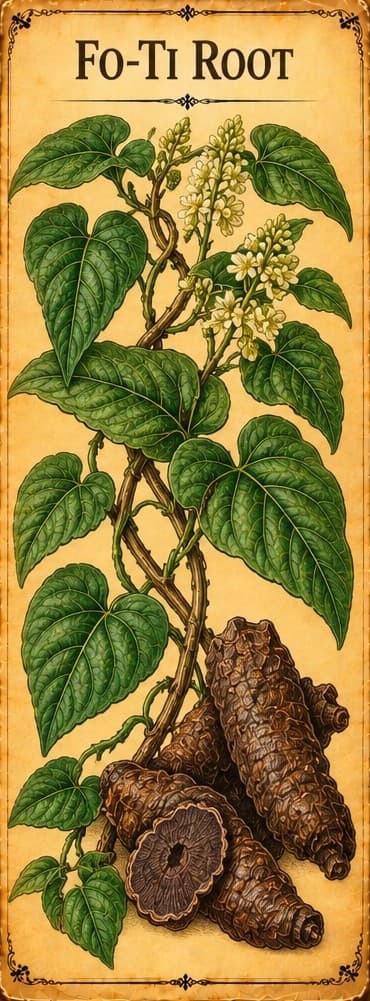
Fo-Ti
Reynoutria multiflora
He shou wu, a popular Chinese root traditionally taken to darken graying hair, as an anti-ageing tonic, and for dizziness and constipation. Hundreds of cases of liver injury have been linked to it, a few of them fatal.
What is Fo-Ti?
- Plant family
- Polygonaceae, the buckwheat and dock family
- Parts used
- The root, used raw or processed (boiled in black-bean liquid), as slices for decoctions or in patent medicines such as Shou Wu Pian
- Where it grows
- China
- Genus
- Reynoutria
- Species
- multiflora
Also called
Fo-Ti Root, Chinese Knotweed, Shou Wu Pian
Traditional names
He Shou Wu, Heshouwu
Older scientific names
Polygonum multiflorum
Traditionally used for
- Graying hair (traditional)
- Hair loss (traditional)
- Anti-ageing tonic (traditional)
- Dizziness (traditional)
- Constipation (traditional)
- Lower back pain (traditional)
- Blood fats (traditional)
Traditionally described as
Health topics
Where Fo-Ti appears in symptom search, and why. Being listed doesn't mean it's a proven treatment.
- Constipation
The raw root is traditionally used to relax the bowels. Not tested in trials, and it can damage the liver.
- Hair Loss
Processed fo-ti is traditionally taken to darken graying hair, and gray hair and hair loss were the most common reasons people took it in reported liver injury cases. Not shown to work in trials, and it can damage the liver.
- High Cholesterol
Traditionally used to lower blood fats, and it lowered blood fats in animal studies. Not shown in people, and it can damage the liver.
- Liver Safety Warnings
One of the herbs most often linked to liver injury; hundreds of cases have been reported, a few fatal.
Traditions that use it
Traditional Chinese Medicine
Called he shou wu; first recorded in the Kaibao Bencao (973–974 AD). Processed root is used to darken hair, nourish the liver and kidneys and as an anti-ageing tonic; raw root to relax the bowels.
Safety
Toxicity testing
Fo-ti can damage the liver. A review of 450 reported cases found symptoms usually began about a month after starting it: yellow skin or eyes (jaundice), tiredness, loss of appetite and dark yellow urine. Most people recovered after stopping it, but 7 died and 2 needed a liver transplant. Many cases involved taking it for a long time or in high doses. The reviewers advise anyone taking it to watch for signs of liver damage.[1]
Contamination
Both raw and processed fo-ti have been linked to liver injury. The substances responsible haven't been identified, and poor quality control is a major safety concern.[2]
What does the research say?
Traditional use
These are traditional uses, not proven treatments.
Fo-ti, called he shou wu in China, is a popular Chinese medicine. It's used raw or processed, as decoctions and in patent medicines. Clinical studies have looked at its traditional uses and at possible effects on blood fats and diseases of the brain and nerves.[2]
Fo-ti was first recorded in the Kaibao Bencao, a Chinese materia medica from the Song Dynasty (973–974 AD). The Chinese Pharmacopoeia lists two forms with different traditional uses:
- Raw root: to "clear toxins" (a traditional Chinese idea), for boils and abscesses, to prevent malaria and to relax the bowels
- Processed root (boiled in black-bean liquid): to nourish the liver and kidneys, "supplement essence and blood", darken graying hair, strengthen bones and muscles, "eliminate dampness" and lower blood fats
Its best-known product, Shou Wu Pian, is usually taken as an anti-ageing product or a tonic for dizziness with ringing in the ears. It's also used for premature graying of hair, lower back pain, involuntary loss of semen, vaginal discharge and constipation.
In reported cases of liver injury, the most common reasons people had taken it were gray hair and hair loss. Others included high blood pressure, heart disease, high blood fats, osteoarthritis, sleep problems, dizziness and general health.[1]
Laboratory & animal research
Lab and animal results show what might be worth studying in people. They don't show that the herb has these effects in humans.
In lab and animal studies, fo-ti has lowered blood fats and slowed hardening of the arteries, protected the liver, affected the immune system, protected nerve cells and improved memory, and shown antioxidant and anti-ageing effects. These haven't been confirmed in people.[1]
In short
Can cause serious liver damage, sometimes fatal; watch for yellow skin or eyes, dark urine and tiredness.
Sources
- [1] Liver Damage Associated with Polygonum multiflorum Thunb.: A Systematic Review of Case Reports and Case Series · DOI: 10.1155/2015/459749Review or clinical trial
- [2] Polygonum multiflorum-Induced Liver Injury: Clinical Characteristics, Risk Factors, Material Basis, Action Mechanism and Current Challenges · DOI: 10.3389/fphar.2019.01467Peer-reviewed study
This information is educational and traditional in nature, and is not a substitute for professional medical advice.