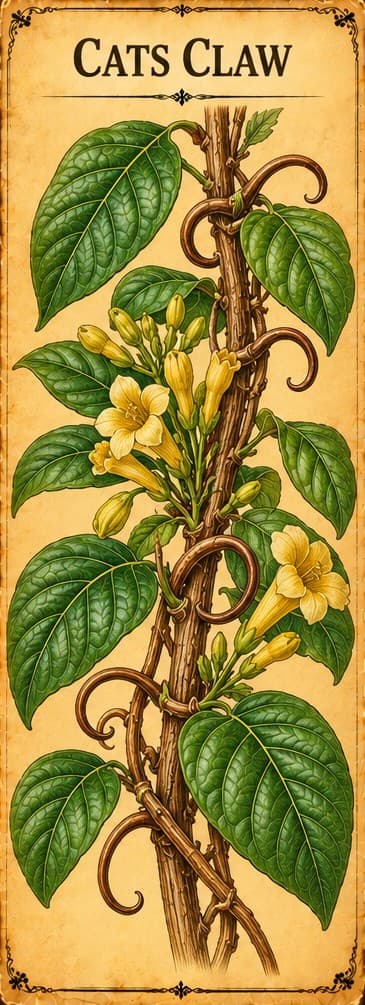
Cat's Claw
Uncaria tomentosa
A woody vine from the Amazon rainforest, named for its hooked thorns, used by Indigenous Amazonian peoples for centuries and now promoted for arthritis. There's no conclusive evidence it helps any health condition.
Cat's Claw may interact with some medicines. If you take any medicine, read Interactions with medicines below and talk to your doctor or pharmacist before using it.
What is Cat's Claw?
- Plant family
- Rubiaceae, the coffee family
- Parts used
- The bark and root of the woody vine
- Where it grows
- The Amazon rainforest and other tropical areas of Central and South America
- Genus
- Uncaria
- Species
- tomentosa
Also called
Cats Claw
Regional names
Uña de Gato
Older scientific names
Uncaria guianensis
Traditionally used for
- Arthritis (promoted)
- Immune support (promoted)
- Traditional Amazonian remedy
Traditionally described as
- May stimulate the immune system
Health topics
Where Cat's Claw appears in symptom search, and why. Being listed doesn't mean it's a proven treatment.
- Joint Discomfort
Promoted for osteoarthritis and rheumatoid arthritis, but there's no conclusive evidence from studies in people.
Safety
Interactions with medicines
Cat's claw may slow blood clotting and increase bleeding during surgery. It may interact with blood thinners, anti-platelet medicines and blood pressure medicines.[1]
Who should avoid it
Cat's claw may stimulate the immune system, which could make autoimmune diseases worse. It's considered safe to take by mouth for up to 6 months.[1]
Pregnancy
Some studies suggest cat's claw is unsafe during pregnancy. Its safety while breastfeeding is unknown.[1]
What does the research say?
Traditional use
These are traditional uses, not proven treatments.
Indigenous peoples of the Amazon have used cat's claw for centuries to prevent illness. Today it's promoted for osteoarthritis, rheumatoid arthritis, cancer, viral infections and COVID-19. Most products sold in the US contain Uncaria tomentosa.[1]
Research in people
There's no conclusive evidence from studies in people that cat's claw helps any health condition. Many of the existing studies were poorly designed or too small.[1]
In a small 2001 study, 12 healthy adults were split into 3 groups: 250 mg or 350 mg a day of a water extract of cat's claw (Uncaria tomentosa) for 8 weeks, or nothing. When their blood cells were exposed to a chemical that damages DNA, the cells of people taking cat's claw had less DNA damage and repaired it better. No harmful effects showed up in symptoms or blood tests. The study was very small and didn't test whether this prevents or treats any disease.[2]
Technical detail: C-Med-100 extract; DNA damage induced by hydrogen peroxide; p < 0.05 versus non-supplemented controls.
In short
May worsen autoimmune diseases and slow blood clotting; some studies suggest it's unsafe in pregnancy.
Sources
- [1] Cat's Claw: Usefulness and Safety — National Center for Complementary and Integrative Health (NIH)Government health agency
- [2] DNA repair enhancement of aqueous extracts of Uncaria tomentosa in a human volunteer study · DOI: 10.1078/0944-7113-00045Peer-reviewed study
This information is educational and traditional in nature, and is not a substitute for professional medical advice.