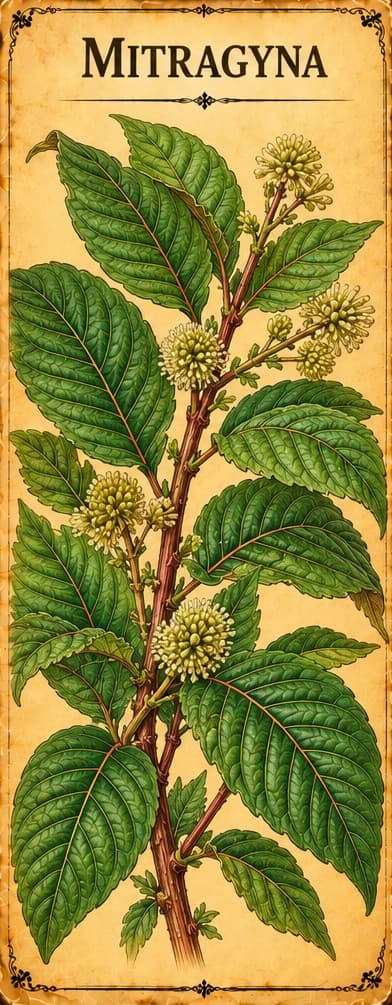
Mitragyna
Mitragyna speciosa
Kratom, a Southeast Asian tree whose leaves act like a stimulant at low doses and like an opioid at higher doses. People use it for pain and opioid withdrawal, but the FDA has warned against it and it can cause dependence.
What is Mitragyna?
- Plant family
- Rubiaceae, the coffee family
- Parts used
- The leaves, as capsules, powder, tea or liquid extracts
- Where it grows
- Southeast Asia
- Genus
- Mitragyna
- Species
- speciosa
Also called
Kratom
Traditionally used for
- Pain (self-treatment)
- Opioid withdrawal (self-treatment)
- Energy
Traditionally described as
Safety
Toxicity testing
Common side effects include nausea, constipation and dizziness. Rarer but serious effects include seizures, high blood pressure, liver problems and psychiatric symptoms. People can become dependent on kratom and have withdrawal symptoms, though this is still being studied. A small number of deaths have been linked to kratom, mostly involving other drugs or contaminants.[1]
Contamination
Kratom products may contain heavy metals and harmful bacteria. The FDA has warned people not to use kratom.[1]
What does the research say?
Traditional use
These are traditional uses, not proven treatments.
Kratom is a tree native to Southeast Asia. Products made from its leaves are sold as capsules, powders, teas and liquid extracts. People report using it for pain, opioid withdrawal and mental health problems. In 2021, about 0.6% of Americans aged 12 and over said they'd used it in the past year.[1]
Laboratory & animal research
Lab and animal results show what might be worth studying in people. They don't show that the herb has these effects in humans.
Kratom's main compounds act on the same brain receptors as opioids, but produce only part of an opioid's effect. At low doses it acts like a stimulant, raising energy, alertness and heart rate. At higher doses it acts more like an opioid, causing relaxation, drowsiness, pain relief and confusion.[1]
Technical detail: mitragynine and 7-hydroxymitragynine are partial agonists at mu-opioid receptors.
Research in people
The National Institute on Drug Abuse is funding research into whether kratom could help treat any conditions. It hasn't been approved for any medical use.[1]
In short
Not approved by the FDA; can cause dependence, seizures, liver problems and high blood pressure, and products may be contaminated.
Sources
- [1] Kratom — National Institute on Drug Abuse (NIH)Government health agency
This information is educational and traditional in nature, and is not a substitute for professional medical advice.