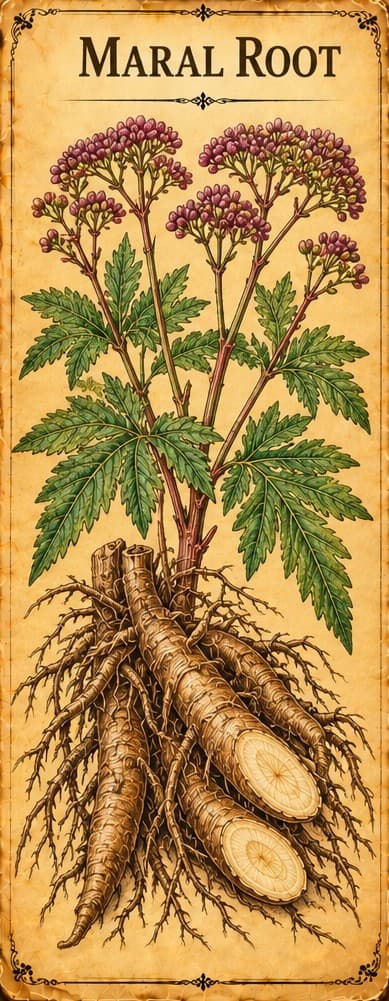
Maral Root
Rhaponticum carthamoides
Russian leuzea, a plant whose root has been used for centuries in eastern Russia. Researchers have suggested it may be an adaptogen, but most research is from Russian lab and animal studies.
What is Maral Root?
- Plant family
- Asteraceae, the daisy family
- Parts used
- The root and underground stem
- Where it grows
- Eastern Russia
- Genus
- Rhaponticum
- Species
- carthamoides
Also called
Russian Leuzea, Leuzea
Older scientific names
Leuzea carthamoides
Traditionally used for
- Traditional Russian remedy
- Physical work capacity (animal studies)
Traditionally described as
- Adaptogen (traditional)
- Antioxidant (in lab studies)
Health topics
Where Maral Root appears in symptom search, and why. Being listed doesn't mean it's a proven treatment.
- Fatigue
Studied, mainly in animals, for effects on physical work capacity. Not well tested in people.
Safety
Toxicity testing
The 2009 review's authors described its preparations as "hopefully safe", but its safety in people hasn't been well studied.[1]
What does the research say?
Traditional use
These are traditional uses, not proven treatments.
Maral root has been used for centuries in eastern Russia as a medicinal plant. Researchers have suggested it could work as an adaptogen, a plant thought to help the body cope with stress.[1]
Laboratory & animal research
Lab and animal results show what might be worth studying in people. They don't show that the herb has these effects in humans.
Maral root contains ecdysteroids (plant compounds similar to insect hormones) and flavonoids. In lab and animal studies, mostly published in Russian, its extracts have shown effects on the brain, blood, heart and nervous system, protein building, physical work capacity, reproduction and sexual function, as well as antioxidant, immune, antimicrobial and antiparasitic activity.[1]
In short
Not well studied in people; most research is in animals.
Sources
- [1] Chemistry and pharmacology of Rhaponticum carthamoides: a review · DOI: 10.1016/j.phytochem.2009.04.008Peer-reviewed study
This information is educational and traditional in nature, and is not a substitute for professional medical advice.