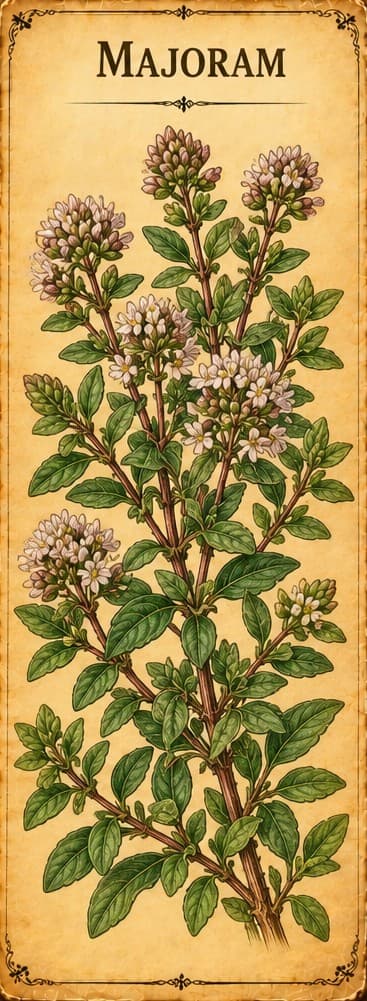
Marjoram
Origanum majorana
Sweet marjoram, a culinary herb of the mint family, used in traditional medicine for digestive, breathing, heart, joint and nerve complaints. Research so far is in the lab and in animals.
What is Marjoram?
- Plant family
- Lamiaceae, the mint family
- Parts used
- The leaves and flowering tops, fresh or dried, and the essential oil
- Genus
- Origanum
- Species
- majorana
Also called
Sweet Marjoram
Older scientific names
Majorana hortensis
Traditionally used for
- Cooking
- Digestion (traditional)
- Coughs and colds (traditional)
- Joint pain (traditional)
Traditionally described as
- Antioxidant (in lab studies)
- Kills bacteria and fungi (in lab studies)
Health topics
Where Marjoram appears in symptom search, and why. Being listed doesn't mean it's a proven treatment.
- Indigestion
Traditionally used for digestive problems. Not tested in trials.
What does the research say?
Traditional use
These are traditional uses, not proven treatments.
Sweet marjoram has been used in traditional and folk medicine for many complaints, including:
- Digestive problems
- Eye, nose and throat problems
- Breathing problems
- Heart complaints
- Joint and muscle pain
- Nervous complaints
It's widely used in cooking and perfumes.[1]
Laboratory & animal research
Lab and animal results show what might be worth studying in people. They don't show that the herb has these effects in humans.
In short
Not well studied in people.
Sources
- [1] Sweet Marjoram: A Review of Ethnopharmacology, Phytochemistry, and Biological Activities · DOI: 10.1177/2156587216650793Peer-reviewed study
- [2] Origanum majorana Essential Oil: A Review of Its Chemical Profile and Pesticide Activity · DOI: 10.3390/life12121982Peer-reviewed study
This information is educational and traditional in nature, and is not a substitute for professional medical advice.