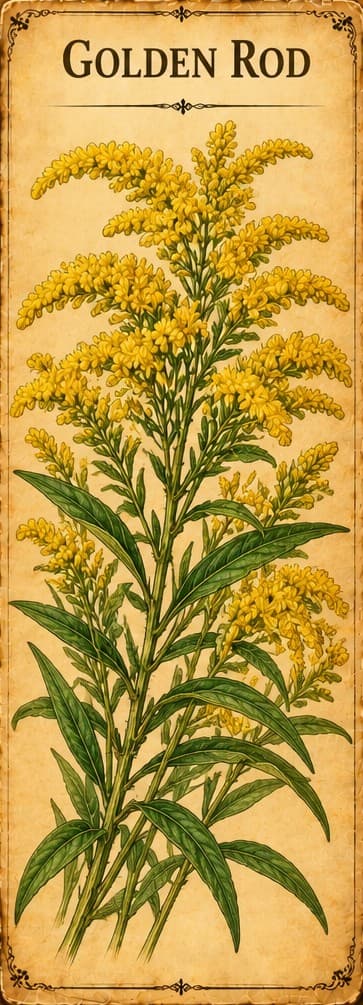
Goldenrod
Solidago virgaurea
European goldenrod, recognised in Europe as a traditional remedy to increase urine flow alongside treatment for minor urinary complaints.
What is Goldenrod?
- Plant family
- Asteraceae, the daisy family
- Parts used
- The flowering above-ground parts, as a tea, tincture or extract
- Genus
- Solidago
- Species
- virgaurea
Also called
European Goldenrod, Golden Rod
Traditionally used for
- Minor urinary complaints
- Increasing urine flow
Traditionally described as
- May increase urination (traditional)
Health topics
Where Goldenrod appears in symptom search, and why. Being listed doesn't mean it's a proven treatment.
- Bladder and Urinary Tract Infections (UTIs)
Recognised in Europe as a traditional remedy to increase urine flow alongside treatment for minor urinary complaints. Based on long use, not trials.
Traditions that use it
European Folk Medicine
Recognised in Europe as a traditional remedy to increase urine flow in minor urinary complaints.
Safety
Who should avoid it
Don't use goldenrod if you're allergic to it or to other plants in the daisy family (Asteraceae), or if you've been told to drink less fluid because of severe heart or kidney disease. Don't take it with prescription water pills. Not recommended for children under 12.[1]
Side effects
Allergic reactions and stomach or gut upset may occur.[1]
Pregnancy
Not recommended during pregnancy or breastfeeding, because there isn't enough data on its safety.[1]
How much to use
See a doctor if you get a fever, pain or difficulty when urinating, cramps or blood in your urine, or if symptoms don't improve. Drink enough fluids when taking extracts.[1]
Technical detail: infusion 3–5 g, 2–4 times daily; liquid extract or tincture 0.5–2 ml, 3 times daily; dry extract 350–450 mg, 3 times daily.
What does the research say?
Traditional use
These are traditional uses, not proven treatments.
The European Medicines Agency recognises goldenrod as a traditional herbal medicine to increase the amount of urine, alongside treatment for minor urinary complaints, in adults and teenagers. This is based on long use alone. It's traditionally taken for 2 to 4 weeks.[1]
In short
Don't use it with severe heart or kidney disease, or if you're allergic to daisy-family plants.
Sources
- [1] Community herbal monograph on Solidago virgaurea L., herba — European Medicines Agency (EMEA), Committee on Herbal Medicinal ProductsGovernment health agency
This information is educational and traditional in nature, and is not a substitute for professional medical advice.